This is an actual CPC fund-raising letter that has been floating around on the internet over the past few days. It is similar in many ways to most other CPC fundraising letters.
Now, let's have a good look at what they say.
I'm sorry to have to do this, but I have some disturbing news to share with you.
Here they are setting the stage. "Disturbing news" sets up a sense of anxiety, perhaps alarm. In psychology this is known as "priming". It's a technique designed to put the subject (the letter recipient) into a certain frame of mind which will enhance the impact of the subsequent information. The use of the phrase "to share with you" implies familiarity. It is intended to make the recipient feel like a part of something, an insider.
I was recently made aware of a plan by Quebec's largest trade union, the FTQ, to attack Conservative candidates in 8 ridings. Even worse, this is part of a larger plan by a group of unions to unseat Conservatives in 60 ridings across Canada!
"I was recently made aware of a plan" makes it sound like this is some sort of dark ops that CPC intelligence has uncovered. The use of the word "attack" makes it seem like something violent and unsavoury is about to occur. "Even worse" - this transfers negativity on the first part. People who receive CPC fund-raising letters frequently are already primed to respond to the word "union" with mistrust, outrage and condemnation. Unions are a central theme common to many CPC requests for money. Unions, media, special interest groups (like First Nations, environmentalists, veterans, women...) are among the favourite CPC bogeymen used to elicit funds.
The plan, called "Beat the Conservatives," is a clear attack on a fundamental Canadian principle of democracy.
"Beat the Conservatives" is a pretty lame slogan. I would have thought the unions could have come up with something catchier. Be that as it may, the rest of the sentence is twisted. "A clear attack on a fundamental Canadian principle of democracy" - so, if anyone challenges or campaigns against the CPC, they are being undemocratic. This is clearly a use of the word "democracy" with which we are unfamiliar. The suggestion is that not only is the CPC the bastion of Canadian principles, but anyone who opposed this "truth" is opposed to democracy. Take a moment to get your head around that.
We're fighting back - but we won't be able to do so without your help. Please donate $15 to help us in this fight.
And here is the ask. $15, they say, is essential to beat back this undemocratic evil conspiracy.
It's this simple. We're up against a secretive group of union leaders who have access to millions of dollars and a single goal - to defeat Prime Minister Harper and Canada's Conservatives.
They reference "a secretive group of union leaders" - it is really hard to argue that anyone in politics in Canada is more secretive than Stephen Harper and the CPC. This is amusing. This nefarious group "have access to millions of dollars and a single goal" - it's almost as though they were describing themselves! And what is this dreadful goal? "To defeat Prime Minister Harper and Canada's Conservatives" Gasp! How could anyone want that? Well, for many reasons. And, as we thus far live in a democracy (more and more questionable all the time, but let's make the assumption), it is the nature of a democracy for different groups with different ideas of how the country should be run, to compete against one another for the minds of the voters. Who will then, again theoretically, be allowed to cast ballots indicating their preferred representative in Ottawa.
We do not vote for the Prime Minister. They vote for the President in the US, but this is Canada and we just vote for a local representative who may, or may not, be a member of a party. The Prime Minister is only the leader of the party that won the most seats. First among equals, with equals being the most important part of that description. Stephen Harper is not a king by divine right, and opposing him is not treason, even if the spin doctors in the PMO would like to make it sound that way. Finally, Canada's Conservatives are not the Conservative Party of Canada, and vice versa. The CPC co-opted (or stole, if you prefer) the word Conservative to use in their name when Peter MacKay welched on a promise to David Orchard that he would not turn the Progressive Conservative Party over to Stephen Harper and his Reform/Alliance cronies.
They are nothing like the Conservatives of Diefenbaker. If your grandad voted conservative, wonderful. But you don't have a real conservative party to vote for. This lot has confused "conservative" with mean-spirited, uncaring, and riding roughshod over the environment, the people, and the institutions that many associate with Canada, all for the benefit of big business. Real conservatives know the value of a dollar and look to use money wisely, for the greatest benefit. The CPC like to spend a lot of money on advertising and ceremonies and photo-ops and flying their chums around the world... Things that do no tangible good, other than supporting their egos and increasing their control of the message and the minds of Canadians. This is not conservative. They cheat and lie. These are not conservative values. So it is actually insulting to real conservatives for the CPC to claim to represent them.
And we can't count on the Liberals and NDP to speak out against this, as they are the ones who stand to benefit.
Ummm. Yeah. Well, let's go back and think about the common usage of the term "democracy". The opposing parties are not going to side with the CPC against anyone trying to encourage a vote against them. That is just not how the game is played.
We can win this fight - but not without your help. Contribute $15 right now to stand with us.
Again with the bold. the underlining and changing the ink colour to heighten the sense of urgency and reinforce the $15 ask. "Stand with us" - they close as they began, encouraging the reader to feel a part of something, an ally.
The underlying premise of this, and most other CPC fund-raising letters, is not only to rake in piles more money, but to reinforce the notion in people's minds that the CPC is the rightful government and any suggestion that someone else should be elected is somehow seditious. I find it scary that some people read these things and actually just absorb this message and close their minds to other perspectives.
Thank you
At least they are polite, if a bit presumptuous. Canadians really need to think critically when confronted with fund-raising letters, public announcements, talking points, etc...
Don't let the CPC spin doctors bamboozle you with their mind-control tactics!
Tuesday, 20 January 2015
Monday, 5 January 2015
I am Canadian
I am Canadian.
I live in a house, not an
igloo.
I drive a truck, not a
dogsled team (although, I do have a Siberian Husky/Irish Setter cross
– he doesn't like the cold any more than I do).
I believe in the country
providing health care to all, regardless of their ability to pay for
it - we take care of each other.
I believe in a strong and
progressive educational system where children are valued, regardless
of who their family is or what their race, religion, or socioeconomic
status might be – educated children are our future.
I believe in science, because science lets us reach into atoms and out beyond the stars.
I believe that paying
taxes that are used to benefit my community, my fellow Canadians, and
my country is a good thing.
I believe in respecting
the First Nations of our country – we owe them much.
I believe in art, and
music, and literature, I believe Canadians are among the most
talented and creative people in the world and we should rejoice in
that.
I believe in Canada's
Charter of Rights and Freedoms, our constitution and the Supreme
Court of Canada that protects those rights for all of us.
I believe in protecting
the environment for future generations.
I believe in peace, order
and good governance.
I believe the justice
system should be about making society better and helping people cope
and fit in, much more than punishing and disabling.
I believe we should all be
able to follow our dreams.
I believe in keeping the
peace and being an honest broker in the world.
I believe in Canada, but I
think we have lost our way.
I am Canadian.
The "FREE" Press in Canada: An obituary
Today Prime Minister Harper shuffled Julian Fantino out of his post as Minister of Veterans' Affairs and into a less visible spot in his cabinet. Clearly, the PM is cleaning house, dealing with irritants that might get in the way of getting votes. He is assuming a) Canadians are stupid and will forget all about the various gaffes and atrocities in Veterans' Affairs over the past few years and b) Canadians are stupid and don't realize that, as odious as Mr. Fantino appears to be, he is not running anything, everything that happens in this government comes from the PMO and starts in Mr. Harper's head.
CBC news network covered the announcement of this shuffle by reading the press release from the government. That is not journalism. That is reciting the government's talking points. Even when pressed to discuss the implications of this move, the reporter seemed to suggest that now Fantino was gone from this post, everything was hunky dory and all that bad blood between veterans and the government could be put to rest.
Fortunately Tom Mulcair had the guts to get in front of the cameras and come right out and say that what happened in Veterans' Affairs happened because Stephen Harper wanted it to happen. Even so, the commentary on Mulcair's speech was hesitant and careful to stick to repeating what he had said, rather than examining this issue.
In other news... It appears that a video clip of CTV anchor, Don Martin, saying that Harper was "flirting with fascism" when it came out that the PM and the CPC were preparing legislation that would circumvent copyright laws, allowing them to use news footage for campaign ads without compensating the news agency that produced it, has been wiped from the internet.
You can see the comments here but if you click the link to see the clip, you will be informed that Bell media has removed the clip because of copyright issues. Oh, the irony!
The CTV is not entirely virtuous in terms of political objectivity, by the way. It was found in breach of the code of ethics governing Canadian broadcasters in 2009 when Mike Duffy interviewed then Liberal leader Stephan Dion and broadcast clips that were not to be aired and which were later used by the CPC to discredit Dion. Mike Duffy got a senate seat. Dion lost the leadership of the Liberals and Harper won the election.
The attempts to suppress criticism have been many and varied this past year. Probably the most publicized spat between a columnist and the government involved an opinion piece by Toronto Star's Heather Mallick, and the angry response by Conservative Party political operations director Fred DeLorey. Ms Mallick rightly retorted that her job is to express opinion. It is not intended to be neutral or objective. DeLorey attempted to suggest that holding a critical view of the PM or the government was somehow seditious, and he goes on to attempt to undermine the public's faith in mainstream news media: "We’re up against the Liberals and the NDP in the next election, but we also have to fight an uphill battle against all their friends in the Ottawa media. Since we can’t count on fair coverage, we’re going to need to speak directly to voters. It’s not cheap, but it’s the only option."
And in still other news, it seems the federal government doesn't like its staff checking out Blacklock's Reporter. The accredited news source, specializing in parliamentary news, has been blocked on government servers. If you are not familiar with Blacklock's, the publication is not your usual news outlet. You won't see traffic accidents or fires or sports scores. It is a very serious, often very dry medium that deals with the doings on Parliament Hill; bills, regulations, Access to Information and federal courts. They take the quality of their reporting very seriously and, in so doing, have often been critical of the government. Not just this government, by the way, previous governments have not been spared the Blacklock scrutiny.
Not only does the CPC want to make sure federal civil servants are protected from news regarding their places of employment, it has also worked very hard to make information nearly impossible to access by members of the press. Investigative reporter, Mike DeSousa, offers an insight into the difficulty many journalists encounter when trying to do their jobs in Canada these days. Months of waiting to get documents that have been completely blacked out. That is not transparency, or accountability, or access to information.
Many people are unaware that things are deteriorating rapidly here in Canada. Between 2013 and 2014, Canada slipped 10 places in the World Press Freedom Index, landing at 20th. Sad, because in 2002 we were in 5th place. A brief synopsis of the decline in press freedom in Canada can be found here.
But, back to the CBC. Every government has disliked the CBC. This is because the CBC has been doing what it was intended to do: speak truth to power, ask the tough questions, and dig for the deeper story. As an independent publicly-owned broadcaster, the CBC was not reliant on advertising and so could not be pressured by corporate interests to cover events in any particular way. All other mainstream media in Canada is owned by corporate interests and relies on advertisers (other corporations) to be able to operate. This financial reliance leads to a tendency to frame the news in ways that please the corporate interests. It can slant the news, sometimes to the point where it barely resembles the actual facts.
But the CBC, like the BBC, was a public broadcaster, and therefore not beholden to corporate dollars. The Liberals were no fans of the CBC when they were in power, but they accepted that it was part of Canada's cultural fabric. The CPC, and especially PM Harper, do not accept it. They hate it. They hate that public money is supporting any publicly beneficial organization, from Canada Post to the Canadian Wheat Board to Parks Canada. They feel that people should pay for services like postal delivery, health care and education. But they especially hate that public money is supporting an organization that asks questions and sheds light on things they would rather keep hidden.
The CPC war on the CBC goes back well before 2006. Back in the days of the Northern Foundation and the National Citizens' Coalition, Harper was already engaged in a war of words with the public broadcaster. Since gaining power in Ottawa he has steadily whittled away at the CBC, cutting funding, cutting jobs, bad-mouthing the CBC to fund-raise, installing a new Board of Directors comprised of hand-picked CPC supporters... He has even gone so far as to change the bargaining process so the BoD has a say in compensation and staffing. It certainly appears that word has gone out: criticize the PM or the government and your name will go on the list for the next round of job cuts.
The changes are evident, from the cuts in staff, to the choices made in lead stories. The CBC, once the most reliable and relevant news source in Canada, is becoming a mouthpiece for the government. And soon it will be moot. It was recently announced that the federal government has contracted, to the tune of millions of taxpayer dollars, to have a company write "custom" news stories. Back in the day, this was called "propaganda". Soon there will be no need for the CBC, CTV, Global, or the print media. The government will provide all the news they want you to see...
#HarpersRecord: A Sociological Phenomenon
This past weekend I participated in a very interesting social media event. A hashtag on Twitter emerged, #HarpersRecord, inviting Canadians to recall just what our Prime Minister has done. With an election coming up this year, it seems only fair to take a good look at the record he seems so proud of.
The participation in this event was surprisingly large. Launched on Saturday afternoon, the hashtag trended in Canada several times Sunday morning. One thing was clear, a lot of Canadians are ANGRY.
Another interesting observation is that there was almost no "troll" activity. Does that mean CPC supporters didn't notice the thread? Does it mean that the documenting of Harper's record in government was such that they could not argue? Or does it mean that the PMO staff were off for the weekend so there was no one around to write up talking points and give the paid trolls their marching orders?
Participants added statements, photos, news links, opinions, and frustration. And the thing is, it's all documented. From closing libraries, to cheating in elections, to abandoning the long-form census, to removing protection from our waterways, to raising the OAS age to 67, to making it harder to get EI, to closing Veterans Affairs offices and returning over $1B to the treasury that was earmarked to be spent on veterans, to running a full-time propaganda machine, and more.... It is all on record. None of this is opinion. There is nothing that can be denied about Harper's record. The question is, will Canadians ignore this record and return Harper to power for another 4 years? Or will this collective rage finally get us up off our couches and out to the polling stations in unprecedented numbers to make sure these things never happen in Canada again?
To view #HarpersRecord, go here.
If the link doesn't work for you, let me know in the comments section and I will try to do something different so everyone can see.
Monday, 8 December 2014
Lies... Damn Lies! And Statistics! Justice System Edition
Despite the rates of all sort of crime going down in Canada, the Harper Government, in their great wisdom, have decided we need more prisons. Now, I realize this make no intuitive sense. If crime is going down, surely we may be looking at fewer prisons, right? Not so, said Stockwell Day. No, he said, we need more and bigger prisons because of an alarming increase in unreported crime.
Unreported crime... Next they'll be saying we need more animal control officers to round up all the unreported unicorns.
According to the CBC, "Statistics Canada says the country's homicide rate fell last year to 1.44 victims for every 100,000 people, its lowest level since 1966." 1966! The lowest homicide rate in 48 years! But we still need more and bigger prisons. This is because Canada's prison population is at an all-time high. Let's get our minds around this now... The crime rate is falling steadily, and we are putting more people in prison? Is the crime rate falling because most of the criminals are now in jail? That might be a simple way to look at it. But, as with many things, the simple answer is not the correct one.
The Canadian population, as a whole, is getting older. We're just not getting into mischief like we used to. So, why so many people in prison?
Let's look at the Harper Government's stance on justice and prisons. Harper is really, REALLY into punishment. He has no time or patience for ideas like prevention, harm reduction, rehabilitation.. His world is black and white - there are those who are good and do what they are told, and there are the others who are clearly morally inferior and need to be punished. And grinding other people down does give some people a sort of ego-boost, it makes them feel powerful and in control.
So, Harper has decided to follow the Bush-era US model of "justice". The United States accounts for a mere 4.43% of the world's total population. Yet they also have a full 25% of the world's incarcerated population. One in 39 Americans is now either behind bars, on parole, or on probation. If you believe that being "tough on crime" and locking people up for longer and longer makes the streets safer, then by this reasoning, downtown areas of American cities should be about the safest places on earth, right? Are they? No. They are not. In fact, they are becoming increasingly dangerous places.
Private prisons became a thing in the US, with some prison corporations gaining the contractual right to sue a state if the population of inmates was not maintained. This article explains how that works. More laws, longer and stiffer penalties help to keep prison populations up to the required 80%-100% occupancy. What does this mean for people?
When a person is arrested and charged, the state is highly motivated to convict them and make sure they receive the longest prison time possible. If you are poor and can't afford a lawyer, you are pretty much sure to be convicted, regardless of your innocence. If you are a person of colour, your chances of being found guilty are substantially increased as well.
For-profit prisons follow the business model of reducing costs to increase profit. This means the insides of prisons are generally bleak, over-crowded and highly regulated. Food is sufficient to sustain life. Education, rehabilitation and mental health programs are expensive, and so are minimized or eliminated. Staff is kept at a bare minimum, which results in a lot of time in "lock-down" where prisoners are confined to their cells because they are more manageable that way. Apart from being dismal, depressing and depersonalizing, prisons can often be highly dangerous. Despite the danger of the situation, suicide is the leading cause of death in prison in many states in the US.
Eventually, if you survive, they have to let you out. What then? You have served your time. Do you get to start over? Not so fast. Most employers will not hire ex-cons. In the US, if you are convicted of a felony (and the meaning of the term felony varies from state to state and can result in sentences ranging from 5 days to death), you are no longer able to vote, ever. So, you can't get a job, you can't vote. You become marginalized. Some do find work with benevolent employers, but many wind up on the streets. Their underlying issues that got them into trouble in the first place have not been addressed, and now they are even more disadvantaged than before. Does this sound like a way to reduce crime?
"Even if the rate of crime were trending upward, building more prisons would not suppress the crime rate, said Craig Jones, executive director of the John Howard Society of Canada.
“To suppress the rate
of crime, you have to frontload your welfare system so all your children
have adequate nutrition, they live in non-violent, non-traumatizing
environments — because that’s where your violence originates,” Jones
said." in an article in the Toronto Star.
So, the US has begun to roll back its "tough on crime" policies. They are recognizing they DO NOT WORK to either reduce crime, or to make communities safer or society better. Texas, for goodness sake, is changing its justice system, because "tough on crime" doesn't work.
"(Chuck) DeVore (a former California Republican Assembly member and conservative candidate for the U.S. Senate) testified that Texas is closing prisons, reducing its prison population and saving millions of taxpayer dollars - and its crime rate is going down.
How is this happening? Texas is investing in alternatives to incarceration that are proving to be cheaper and more effective at keeping people out of prison. It is also doing a better job of rehabilitating people to keep them from reoffending and ending up back in prison.
Texas uses risk-assessment and better probation procedures to divert large numbers of nonviolent offenders away from the prison system, keeping them away from hard-core criminals. It requires strict implementation of victim-restitution measures, while offering alternatives to prison such as civil sanctions, drug courts and drug-abuse and mental health treatment. It also offers rehabilitation programs like job training for those in prison to prepare them to re-enter society. And Texas has invested heavily in reducing the caseloads of parole and probation officers so the state can keep better track of the people it supervises and help them move in a new direction.
It's paying off. Texas has closed three state prisons, and almost two-thirds of Texas parolees are employed." See the full article here.
So, the US has begun to roll back its "tough on crime" policies. They are recognizing they DO NOT WORK to either reduce crime, or to make communities safer or society better. Texas, for goodness sake, is changing its justice system, because "tough on crime" doesn't work.
"(Chuck) DeVore (a former California Republican Assembly member and conservative candidate for the U.S. Senate) testified that Texas is closing prisons, reducing its prison population and saving millions of taxpayer dollars - and its crime rate is going down.
How is this happening? Texas is investing in alternatives to incarceration that are proving to be cheaper and more effective at keeping people out of prison. It is also doing a better job of rehabilitating people to keep them from reoffending and ending up back in prison.
Texas uses risk-assessment and better probation procedures to divert large numbers of nonviolent offenders away from the prison system, keeping them away from hard-core criminals. It requires strict implementation of victim-restitution measures, while offering alternatives to prison such as civil sanctions, drug courts and drug-abuse and mental health treatment. It also offers rehabilitation programs like job training for those in prison to prepare them to re-enter society. And Texas has invested heavily in reducing the caseloads of parole and probation officers so the state can keep better track of the people it supervises and help them move in a new direction.
It's paying off. Texas has closed three state prisons, and almost two-thirds of Texas parolees are employed." See the full article here.
Other countries have long employed more successful models of justice and rehabilitation. Norway and Sweden are striking examples. In Norway, the recidivism rate is below 20%. Compare that with over 50% in much of Europe and the US. How do they do that?
They treat prisoners with respect and work to address the problems that resulted in their crimes. They have the philosophy (which, incidentally is also in place in Canadian law) that prison is supposed to be seen as a last resort and
should be used as little as possible for the shortest time necessary. In light of this, mandatory minimums in Canada may well
be in contravention of our Criminal Code unless Harper has stricken this underlying concept from the books in one of the many omnibus bills. As well, they operate on the principle that prisoners continue to have human rights and are sent to
prison as punishment, not for punishment. In other words, the loss of freedom is the punishment. Loss of freedom, not loss of human dignity, not threats to personal security, not being subjected to abuse, not brutality, poor living conditions, poor food... Loss of freedom. Period. Please see related articles here, here, and here. There is also a heavy emphasis on alternatives to jail: fines, community service, etc. that keep a lot of people out of jail in the first place. Backed up with social supports such as educational programs, drug addiction rehabilitation, mental health care and so on, Scandinavian countries keep their incarcerated population percentage at a scant fraction of that in the US.
Apart from the glee some feel in inflicting revenge on others, there is little good to be served by producing a prison system based on misery and suffering. This study, produced by the Pell Centre for International Relations and Public Policy, examines the benefits of a Nordic model of justice. In comparing the Scandinavian and American systems, the authors point out the extreme costs to a society, both in the actual cost of maintaining prisoners and also in the costs of broken families, future re-offenses, and a population that emerges from the corrections system in worse shape than when it went in, as is generally the case in a punitive-style system.
Comparing the two:
There are so many studies that demonstrate empirically that this Scandinavian humanist model is far superior to the US-style punitive model... Even the US has begun to dismantle its more extreme laws and practices. It costs far less and results in lower re-offence, lower crime rates, lower damage to society as a whole... And yet, Harper is dead set on furthering his strategy of costly punitive "tough on crime" legislation.
The CPC introduced Bill C-10, whimsically named the "Safe Streets and Communities Act", which imposes harsher penalties, reduces alternative remedies, makes it harder to get parole or a pardon, and extends adult-sized sentences to youth offenders. What all these things do, as the studies have shown, is the exact opposite of making streets and communities safer. This approach reduces offenders to forever being the worst thing they have ever done. They have to wear it, like a scarlet letter, the rest of their lives.
Harper snubs his nose at science and empirical evidence and goes for the far more satisfying retribution and suffering approach. "An eye for an eye" is barbaric and Old Testament. This is 2014. We call ourselves civilized. And yet, there are sufficient among Harper's base of support who will be chuffed to think of all those "thugs" suffering, languishing, maybe even being abused during their long, long stay in prison, that this makes sense to the PM.
Should not the aim of a justice and corrections system be to improve people so they function well in society? All the indicators suggest that a humanist, supportive approach is the most effective and least costly way to do this. Our government's steadfast march in the opposite direction makes no objective, factually supportable or rational sense.
Sunday, 7 December 2014
Newspeak: A Harper Government Lexicon
"‘When I use a word,' Humpty Dumpty said, in rather a scornful tone, ‘it means just what I choose it to mean—neither more nor less.'
‘The question is,' said Alice, ‘whether you can make words mean so many different things."
‘The question is,' said Humpty Dumpty, ‘which is to be master—that's all.'"
- "Through the Looking Glass", Lewis Carrol
Just like Humpty Dumpty, and the Big Brother Government in 1984, Stephen Harper and those who read his PMO talking points attempt to change our understanding and use of language. Stephen Harper is certainly not the first leader in world history to work to change the meaning of language to suit his own ends. But he is the first to do so in Canada so intensively, and backed by such a legion of psychology-based spin doctors and communications specialists, as well as several thousand paid trolls whose role it is to attack, disrupt and change the conversation on social media anywhere criticism of the government might be found. So, as a handy guide, I provide you with a partial glossary of CPC Newspeak, so that you might be prepared to engage your critical thinking when these terms come up.
CLEAR/CLEARLY: This is one of Harper's favourites. "Let me be clear" or "Clearly...." The party ran on a platform of transparency and accountability in 2006.
FAIR (as in "Fair Elections Act" or "Fair Taxation for Families"): When I think of the concept of fairness, I think of something that levels the playing field in some way. Something that makes it possible for those with fewer advantages, to compete with those who have more advantages. The dictionary defines fair as:
By the traditional definition of "fair", a fair elections act should make elections potentially winnable by any party without systemic barriers to any, and should make all potential voters equally able to vote. However, by the CPC definition of "fair", a fair election is one in which they have a marked advantage over any other party and those voters least likely to vote for them may encounter barriers preventing them from exercising their franchise. This is a page straight out of the American Tea Party playbook. In recent years, the far right in the US has appeared to be working hard to devolve their democracy back to an age where only white men with property could vote.
What the CPC have done is change electoral ridings, splitting hard-core CPC support ridings in two to add seats to their side of the house. They have opened the doors to increased campaign spending, knowing full well they are the only party with enough money to take full advantage of this, and they have brought in new ID requirements for voters which may not be accessible to all eligible voters, particularly the young, the poor, First Nations... groups that typically would not vote CPC.
Throw in changes to the powers of Elections Canada, or rather, removal of powers from Elections Canada, which makes it harder to get people out to vote, prohibits the teaching of school children about elections, and makes it impossible for EC to investigate suspected election fraud, and the CPC seem to have stitched up the next and every subsequent election in their favour. This is clearly a new meaning of "fair".
By the same token, a fair taxation program for families should set tax benefits to allow less affluent parents to provide their children with advantages similar to those available to more affluent parents. Sounds good, right? But, under the CPC definition of fair, it means something quite different. Their fair taxation for families plan will only benefit the top 15% of Canadian families who also adhere to the 1950s value set of staying together and having one parent (usually Mom) stay home with the kids. Nothing for single parents. Nothing for two-income families where both parents make a similar amount. Nothing for those who are struggling. The income-splitting plan is a reward to families like Harper's. No one else. Only in the CPC dictionary is that "fair".
SPECIAL INTEREST GROUP:
According to Wikipedia:
A Special Interest Group (SIG) is a community within a larger organization with a shared interest in advancing a specific area of knowledge, learning or technology where members cooperate to affect or to produce solutions within their particular field, and may communicate, meet, and organize conferences. The term originated on CompuServe, an early online service provider, where SIGs were a section of the service devoted to particular interests.
And yet, in the Harper lexicon and increasingly in common use, a special interest group is an obstructionist entity whose motives are deeply suspect. In the past, corporations or industry associations would send "lobbyists" to Ottawa. These lobbyists would try to get the ear of a Minister and influence government policy-making in ways that would benefit their company or industry. Under Harper, corporate groups are now "partners", as in, "The Alberta Department of Education is now partnering with the oil and gas industry to develop curricula for K-12 schools in the province". (Yes, it's true). On the other hand, groups of concerned citizens, such as First Nations bands who do not want a pipeline or a mine on their land, or Veterans who want better access to care, are now "Special Interest Groups". They are linked with the spectre of "foreign funding", radicalism, and possibly terrorism. Never mind that much of the oil and gas industry is foreign-owned or funded, Conservative think-tanks like the Fraser Institute receive vast donations from the likes of the Koch brothers from the US... No, according to Harper, the real threat to our country is citizens trying to protect their land and their rights. Something is very wrong with this. Citizens are not "special interest groups", they are people trying to live in the country with the advantages of clean air, water, environment, safe roads, good schools, and good governance.
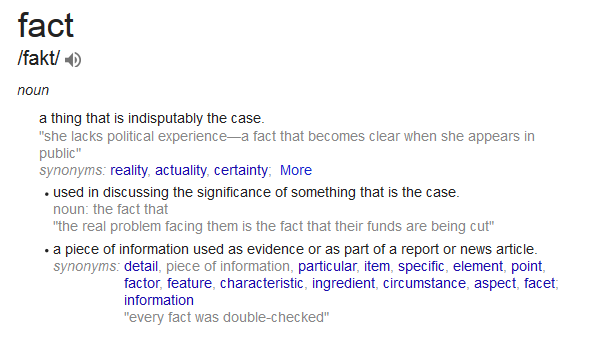
FACT
Now we all think we know what facts are, right? Just to be sure we are starting at the same point, facts are defined as:
To cut to the chase, here is Canada's ranking adjusted for the essential factor of population growth (often ignored in Harper government calculations):
So, what does "fact" mean to the Conservative Party of Canada? A clue might be found in this 2011 ad from Craigslist seeking professional CPC-oriented trolls to disrupt progressive discussions in social media:
"Ideally you can find or make up facts and statistics to stir controversy."
"Make up facts and statistics" Let that sink in for a moment.
If a "fact" is made up, how can it be a "fact"?
If you follow this line of thinking through to it's logical conclusion... If our government feels facts are whatever plausible statement that is advantageous to say at the moment, then what are they basing their policy decisions on? If facts are irrelevant (evidenced by the elimination of the long-form census, the suppression of scientists and the refusal to accept expert testimony and empirical evidence), then is our country being governed based on whatever Harper wants to do? Whatever whim pops into his head?
ACADEMICS/INTELLECTUALS
Closely related to facts, evidence, and empirical knowledge, is the concept of academic or intellectual expertise. At one time, people respected those who had worked hard to learn all they could about a subject, conducted research, experimentation, engaged in debate with other experts in order to further a field of study. There is both a vilifying of academics (used by Harper to discredit Michael Ignatieff, for example), and a perceived leveling of the knowledge base. The attitude that "My ignorance is as good as your expertise" may make the average person feel comfortable talking about issues like climate change and the economy, and it is important that we all have those discussions, but it becomes dangerous when it has real world implications. For example, the In-Site Safe Injection Program in Vancouver has been shown in longitudinal studies to reduce harm, save lives and help otherwise hopeless people access services that lead to improvement in their lives. The CPC have been trying very hard to shut them down because they don't agree with the program. It offends them to help people with addictions, rather than punishing them by throwing them in jail. So, on the one hand we have evidence-based facts, and on the other hand, we have dogma and opinion. The right-wing view does not believe in harm-reduction, or, generally, science. Fortunately, the Supreme Court still does. The uninformed gut response of Harper and his right-wing base is to shut down In-Site because it offends their personal sensibilities, and that would almost certainly result in deaths, which is demonstrated by the scientific evidence.
To put it another, maybe more accessible, way: you wouldn't ask some random person you met on the bus to take your appendix out, would you? Why not? If everyone's ignorance is as good as those academic elites' knowledge, then certainly that guy that works at Wendy's is just as qualified to perform surgery as a surgeon. Right?
No? So maybe, those who have studied specific fields intensively for many years maybe, just maybe, might have an edge on your gut feeling.
But those who know things, because they have studied and conducted experiments and gathered evidence, often disagree with the Harper Way. So, it is useful for him, if not for Canadians, to influence the common perception of academics, scientists, and intellectuals to make sure people see these individuals in a negative light, and their advice, statements, and studies as discredited and irrelevant.
BIG UNIONS/BIG UNION BOSSES
Unions are one of the favourite bogeymen for the CPC, especially when fundraising. "You should send us money...because UNIONS!!!!!"
There are several large unions in Canada that have negotiated good wages, good benefits and good retirement packages for their members. It's a strange thing that some people resent them for this. It is similar to saying, "It's not fair, my car wouldn't start this morning but my neighbour's car did. To make things fair, my neighbour's car should not start either." To put it another way, if you and another employee at the same company have identical credentials and experience, have been in your identical jobs the same amount of time and you find out the other person makes more money than you do, do you demand that their pay be reduced to match yours? Or do you demand that your pay be increased to match theirs? Does it not make more sense, and result in a better situation for everyone, if people work to gain better working terms for themselves and their co-workers, rather than spending time resenting others who have already managed to improve their circumstances?
A second issue that makes it easy for governments to vilify unions is that union actions are disruptive. They are inconvenient. This is the power behind the labour movement. They can leverage good wages, benefits and retirement plans because workers united can exert pressure on employers in ways that individual workers cannot. In a capitalist system, the owners of the means of production hold all the cards, unless the workers organize to require that owners share the fruits of the workers' labour. So, yes, strikes are annoying. They make everyone's life difficult. And people, in general, have lost sight of the higher purpose of these actions.
Before the labour movement began, there were no limits to how long people were required to work each day. There were no requirements of giving employees days off - the weekend did not exist in any meaningful way. There was no minimum wage. There were no workplace health and safety regulations. No pension plans. No prohibition on child labour. Employees could be fired for anything, or nothing at all. There were no rules about sexual harassment. Labour unions did not only improve things in their own shops, they also pressured governments into legislating fair working conditions for all workers, unionized or not.
Some people say, well, we have all that now. There is no need for unions anymore. But this is simply not true. There are still those who would like to see minimum wages reduced or eliminated. Companies come up with clever ways to get around workplace standards, to the detriment of workers. One of the Conservative think-tanks (the Frontier Centre on Public Policy) has just begun advocating a return to child labour and a reduction of wages to compensate employers for taking on workers with no experience, i.e. children. Read about it here
Attacks on the gains made by the labour movement are all around us. Temporary Foreign Workers, governments legislating unions back to work (thus removing their power to negotiate for their members), the loss of full-time jobs with benefits in our economy (replaced by cheaper, part-time jobs without benefits).... The gap between the rich and the poor is expanding. Jobs are harder to find, especially for young people. Vast multi-national corporations are controlling more and more of the economy. We need unions as much now as ever, because people as individual workers are becoming even more powerless.
The Harper Government is certainly not the first government to find unions troublesome, but it is arguably the most viscerally opposed to unionization. Unions give power to the common people. Harper does not like to share power with anyone. Unionism and all that comes with it - minimum wages, health and safety standards, etc. - cut into corporate profits, and that is anathema to Harper. It is not true that paying people decently and providing benefits makes consumer goods more expensive. At least it doesn't have to be true. Corporations already making obscene profits should not, in good conscience, make the argument that increases in wages will have to be passed on to the consumer. But among such groups it is a form of extreme sacrilege to suggest that the cost of treating employees decently should maybe be offset by a slight reduction in the profit line.
Canadians do not understand their own system of government. Harper is exploiting this. He can say anything he likes about how government is meant to work and so few people actually know the reality of how it is suppose to work, that he is rarely challenged. This is evidenced by a poll conducted by the Dominion Institute here. Francis Russell does an excellent job of explaining the issue and I encourage you to read her article here. The long and short of it is, coalitions are a perfectly valid form of government in a parliamentary democracy, but Harper made it sound like an evil, illegal plot. This is yet another example of how Harper will exploit the imperfect information available to Canadians to achieve his own goals.
In Conclusion...
The main point I am attempting to get across in all this, Dear Reader, is that not only is Harper trying to change our economy, our justice system, our health care, and our social programs. He is trying to change how we THINK. And he is doing this by carefully manipulating the meaning of words. Language is key to the tools we have to examine issues and reach conclusions about them. The CPC have a huge team of advisors from the US who are especially skilled in manipulating meaning. Nothing that comes out of the mouths of the Harper team, either read directly from the script, or recited, is accidental. Just as in war reporting, terms like "assets" and "collateral damage" are used to sanitize the information, making living breathing soldiers who are someone's sons and daughters into an inventory item (assets), and similarly make living, breathing people who are injured or killed by our soldiers into a vague term (collateral damage) that expresses nothing of blood and pain and loss, so too are the words used by our government meant to make certain unpalatable ideas easier to accept, and make other, previously accepted and valued ideas into negatives. CPC spokespeople are taught key words and how to use them. When they speak, pay attention. Think critically. Look for independent confirmation of their assertions. Don't take them at their word, because it probably doesn't mean what you think it means.
Tuesday, 11 November 2014
Musings on Remembrance Day 2014
As a child, Remembrance Day ceremonies were a strange thing. My Dad was a WWII vet who seldom talked about his service overseas, except for tales of things he did on leave in the UK. We had relatives he visited, and I have a little cat statue he bought in a curiousity shop in London during the blitz. We never went to the public Remembrance Day ceremonies, he never went to reunions or to the legion. He always called these things "a bunch of old guys who want to relive their so-called glory days". But on November 11, at 11 am, whatever we were doing, everything stopped. I recall practicing piano with him sitting beside me as he often did, and he suddenly put his hands over mine to stop me playing. I looked up at him, wondering what was wrong. His eyes were closed and there was a tear on his cheek. I was only maybe 7 years old and felt very confused. After a few moments, he opened his eyes, brushed the moisture from his face and simply said, "Just remembering". And we went on with the piano practice.
(There is no doubt in my mind, looking back, that my Dad was profoundly affected by his experiences. Not just by the pins in his hip or his inner ear damage that affected his balance, but also in his mind. When he was dying and all doped up on painkillers, he was convinced he had crashed behind enemy lines. The nursing home had to put an ankle bracelet on him because he was intent on escaping and getting home. I had many odd conversations with him during that time that made it clear he felt we were both prisoners of war, and the nurses and staff were German soldiers. That was a very hard time, because he was so very anxious and distressed. It was almost a blessing when his illness progressed to where he was beyond those almost lucid kinds of thoughts.)
Years went by... I got a clearer idea of what Remembrance Day was. A recalling of the lives lost fighting an evil in Europe. The young men and women who died fighting to stop Hitler from spreading his tyranny and oppression across the world. The young men and women who died in a far less clear-cut war 20 years before that: The War to End All Wars. That war, the First World War, was supposed to be a final victory for peace. And since then, war has been raging in one form or another around the world.
Certain things about the big Remembrance Day ceremony in Ottawa have always bothered me. I have always felt a profound grief for the Silver Cross Mother. Each year a woman who has lost her child in war is selected to represent all bereaved mothers. It is supposed to be an honour. It is hard to imagine anything more terrible than to bury your children. I feel both sympathy and rage for the Silver Cross Mother. She is selected to bear an honour that probably very few turn down. But she is brought out as a symbol - she is meant to demonstrate to the country that we should be willing to sacrifice our children like this good woman. And that fills me with rage. It is not our children's blood that will make the world peaceful. It is the ability of world leaders to commit to diplomacy and overcome their greed and ideology, to resolve to not go to war.
My Dad used to say, "It's old men that start wars. They should be the ones that have to go and fight them."
War has become an economic proposition. The US and, more recently, Canada, and other countries, have a huge investment in companies whose sole business it is to make weapons of war. Bombs and ammunition have a shelf life. The military industrial complex has a vested interest in keeping wars starting and continuing. Creating a market, if you will. And then there are issues like oil, and land. Some predict fresh water will be the next strategic golden egg that countries will go to war for. Our children are not commodities, or military "assets", to be thrown out as cannon fodder to further a political or commercial agenda.
Seldom has Canada seen a government as militaristic as the Harper regime. I can't think of one in my lifetime. "Honour the troops" days are becoming a frequent part of our sporting events. Endless commemorations of historic battles suck up millions of tax dollars. The War of 1812? Really? Canada wasn't even a country for another 55 years. Revamping our museums to showcase Canada's military history (while downplaying peacekeeping in favour of active combat), creating a huge monument to "the victims of communism", the CBC and other networks spending the week or more leading up to Remembrance Day wallowing in old footage and tape from WWI and WWII, the government engaging in fiery rhetoric in the House and in press conferences - fear-mongering, trying to instill a militaristic patriotism... The worst offender in the media must be the Sun Network, which is now offering these shirts...
And the most recent undignified emotional orgies over the two servicemen killed in separate incidents on Canadian soil a few weeks ago... We live in a world where our brains have been softened by the endless barrage of Jerry Springers and Oprahs and reality TV... A world where people feel the need to writhe and wail and beat their chests, without looking at the facts and examining the evidence. Both those men were killed by lone assailants. Men who had fallen through the cracks, become disengaged in society, suffered from untreated mental illness, one was a homeless addict. Yet the government was declaring both as terrorist attacks before any information had emerged. They are sticking to the story, too, because it so nicely fits their narrative and lends fuel to the fire of militaristic patriotism they are trying so hard to build.
Harper grabbed a big photo op at the funeral of one of the soldiers.
And all of this against the backdrop of our government fighting veterans' groups in court, seeking benefits and care for battlefield injuries. Harper and co. deny that our country has a sacred trust to those who risk life and limb and mental health at the whim of the government. They cut veterans loose just shy of being eligible for their pensions because they have service-related injuries. They offer lump-sum pay-outs to people who have lifetime injuries. These are young people coming home missing limbs, missing eyes, organs, with psychological injuries. They have years, 50 years, 60 years, or more, to live with these injuries and the government wants to pay them off and send them away. Veterans are killing themselves because they are not receiving the treatment they need. That just isn't right.
Harper is in love with the idea of military. He likes the pomp and ceremony, the uniforms, the medals, the explosions, the Edwardian notion of "glory", and the photo-ops with cool, tough-looking equipment. He does not care about the young men and women he sends off to war, just as he does not care about those who come back. He does not care about their families. He does not care about innocent civilians who may be injured or killed overseas. Remaining in power and remaking Canada in his own image is his primary concern. This, coupled with his absolute control of a majority in the House, makes him an exceptionally dangerous Prime Minister.
This Remembrance Day, we should remember that.
*******
Sorry this has rambled a bit. But for a very in-depth but readable account of the Harper government's relationship with the military and veterans, please read: Delay, Deny and Die: The Harper Government and Veterans
Or maybe just this: Gananoque
Three weeks ago, hidden amid the national outpouring of support and grief for Canada’s soldiers Cpl. Nathan Cirillo and Warrant Officer Patrice Vincent, Canada lost another soldier, Johnny Duffney.
Johnny was my friend. He died in relative obscurity, at the age of 49, in his home above a store on Gananoque’s main street, two doors down from the Royal Canadian Legion and across the street from the cenotaph in our town park. Although he had a loving partner and a circle of friends Johnny died alone by his own hand, a victim of the mental illness that ravages many of our returning soldiers. http://m.thestar.com/…
The treatment of our veterans by this government, and the glee with which they send more young men and women into harm's way, is a national crisis, a national tragedy and a national shame!
Subscribe to:
Posts (Atom)