Thursday, 9 July 2020

Language Matters: How the Conservatives Skew Value and Participation in Society

Canadians, language matters. Conservatives know this. They have been deliberately changing our terms of reference for years. We have seen them reframe lobbyists as "partners", and regular folks with local concerns as "special interest groups" (negative connotation)  
In this pandemic it is even more critically important for us to consider the well-being of others. We need to recognize the community we belong to. I would like to suggest a push-back against one of the most insidious changes to popular speech championed by conservatives.
For many years now, conservatives have referred to Canadians as "tax-payers". This has been done deliberately and consistently. And that choice of words has consequences in the way we think about one another.
We need to think of Canadians as "citizens", or "community members", not "tax-payers". It makes a difference. When conservatives speak to "tax-payers" they are immediately excluding all those who are disabled, elderly, unemployed, or working poor, from the body politic. 
Those people are citizens too. They are important community members. Monetizing people is wrong. It leads to statements like Kenney made about people "with modest levels of human capital" deserving a lower minimum wage. And it leads to people accepting that our value is determined by our financial contribution. 
Our value as human beings is not determined by how much we can contribute to the wealth of corporate entities. We are citizens, first and foremost, regardless of our ability to work, or our ability to pay taxes. 
We have now seen, in the shocking report from the Canadian Armed Forces, that seniors in Long-Term Care facilities have been treated barely better than animals in an industrial farm. Warehoused at the lowest possible cost, to continue bringing in a profit from storage fees. 
The conservatives push to reopen the economy regardless of whether it is safe or not, saying it's mostly old people who are dying, so that's alright, suggests they view our senior citizens the way an industrial farm owner views a cow that can't give milk anymore. In short, of diminished or spent ability to contribute to profitability. Effectively, a liability on the balance sheet. 
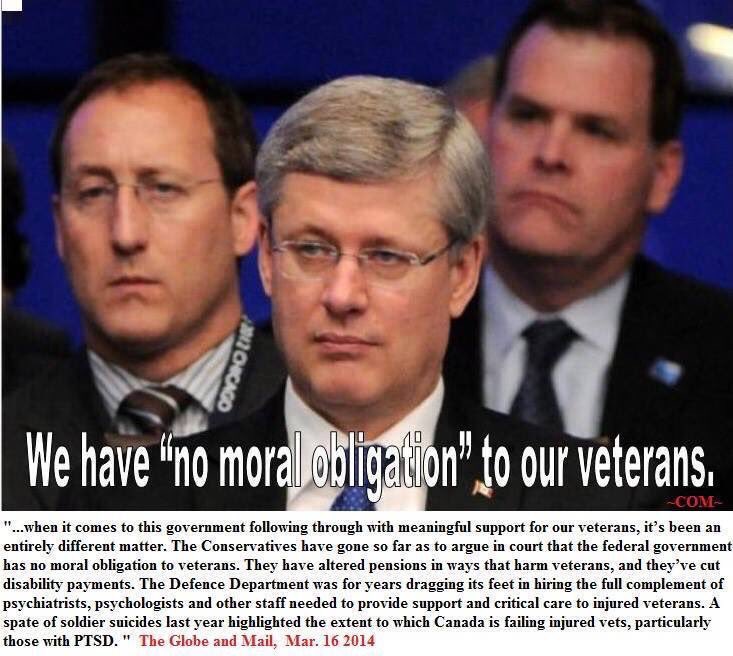
And this is also reflected in the way conservatives have treated veterans. If they can no longer be useful to the country, they are expendable. 
We need to remind ourselves that we are, first of all, members of a society and citizens of a country. We are not "inputs" to an economy. Our value does not depend on our ability to create wealth for corporations. Whatever conservatives may urge to the contrary. 
It is inconvenient to the conservative narrative to recognise the humanity of those who are destitute, addicted, infirm, elderly, disabled, or even the wrong colour or gender or sexual orientation. 
The conservative narrative seeks both to justify disenfranchising those considered "surplus", with no monetary offering to make, and also to divide us and make us accept selfishness and greed through devaluation of others. 
It is time we take back our humanity. It is time we recognize ourselves and all our fellow citizens as having a crucial role in creating and growing our society. We all have non-monetary contributions to make. 
Even the most vulnerable among us, the least able to be self-sufficient and contributing, offers the rest of us lessons in compassion, empathy, responsibility, patience, and caring, an opportunity to appreciate and find joy in things far more valuable than money. 
I encourage everyone to stop using the term "tax-payer". We are Canadians/landed immigrants/permanent residents, we are citizens, we are community members, we are people. We are not units of production, or lines in a ledger. We are not "human capital stock". We are not here to make someone else rich. 
We are here to live our lives. To love and dream and explore and find meaning. To help one another. To enrich our society with art and music and science and important ideas. To protect the earth for the future. To invest in a better quality of life for all. 
The word "tax-payer" does not begin to define us. Let's stop using it. 
I truly believe this is what we need to demand of government. That they treat all as important PEOPLE. When we raise up the most vulnerable, the most impoverished, and the most disenfranchised, we raise everyone up. 

Wednesday, 8 July 2020

Alberta Bill 30 - Introducing For-Profit Medicine in Alberta

(This will likely be the first of several posts examining the 3 controversial bills the UCP introduced yesterday)

With respect to Bill 30, which will increase approval of private, for-profit clinics in Alberta, some thoughts...
There is a cap on certain procedures, like hip and knee replacements, that creates a bottle-neck beyond the limitations of a finite number of surgical facilities. Why is this in place? Why could the government not just remove the cap?
Could it be that the cap will simply accelerate the development of a two-tiered system?
Think for a moment about the private eye clinics in Alberta. They do laser surgery and other "cosmetic" (i.e. not medically necessary) surgeries, but they also do some procedures covered through public health. The public health procedures make the clinic less profit than those for which the patient pays directly. Which types of procedures do you suppose get scheduling priority? It seems obvious that the more lucrative procedures will get the lion's share of the available OR time. The lower paid procedures will fill in gaps, because it's better to have the facilities in use and making some money than standing idle. That is the way for-profit businesses work.
So, for hip and knee replacements in a private clinic, those that are covered by Alberta Health will be less profitable than other procedures performed at a private clinic. They will not get scheduled as quickly as more lucrative procedures. People in pain, and possessing sufficient means, will start asking if they can get their surgery moved up if they pay for it themselves.
The UCP will, at some point down the road, lift the barriers to patients paying for their own surgeries which are covered under the Canada Health Act, saying that the public wants this. Then people with money to pay will get their surgeries sooner, but those who cannot pay will get pushed further back down the line. And this will go on as more people decide to pay, or seek out insurance that will pay.
This would undermine the essence of the Canada Health Act which guarantees all Canadians access to equal health care, regardless of ability to pay.
This is a prediction. The cap keeps a hold on the maximum number of these procedures that can be billed through Alberta Health and therefore keeps these procedures at low priority status in private for-profit clinics. This will incentivize people with the means to pay out of pocket to demand to be able to do so. And it will leave people without the means to pay, further and further behind. And insurance companies will begin advertising products that promise to help those people who couldn't pay for it themselves obtain better access, so long as they pay monthly premiums.
You may be wondering why the UCP would want to see two-tiered medicine in Alberta. Apart from the support the UCP may be receiving from the insurance industry and for-profit health care interests, there is an historical component that contributes to the anti-medicare ideology.
The National Citizens Coalition was founded in 1967 by an insurance agent named Colin Brown. Brown was extremely opposed to the Canada Health Act, which was very new at the time. Obviously, universal health care impinged upon his industry's profitability. People no longer had to buy insurance to pay for any medical care they needed.
The NCC also opposed the Candian Wheat Board, unions, the mandatory long-form census, Liberals, restrictions on third-party election spending, and a number of other things.
In 1997, Stephen Harper resigned as a Member of Parliament for the Reform Party to become Vice-President of the NCC. He became president the following year and remained in that role until 2002, when he took over leadership of the Canadian Alliance Party. These grievances of the NCC clearly aligned with, or helped shape, Harper's political direction.
As PM, Stephen Harper sold the Canadian Wheat Board, discontinued the mandatory long-form census, changed election financing laws, and allowed the provinces great latitude in how the Canada Health Act was administered. This resulted in increased access to for-profit entities in the systems across the country.
Yes, Jason Kenney is not Stephen Harper. But he was Harper's protege. He served Harper for the duration of the CPC government. He has now hired Harper to consult and guide the UCP government's management of the province.
As Prime Minister, Stephen Harper was not able to eliminate the Canada Health Act. Messing with Canadians' health care is political suicide, even in Alberta. So he ignored it, and turned a blind eye to Premiers who were so inclined, as they whittled away at the public system. But installing a system that would be lucrative to the insurance industry and to for-profit health care providers has always been the plan.
Now, behind the scenes, the wheels are in motion.
Governments in Canada have been under intense pressure from lobbyists representing the insurance industry, the for-profit health care industry, and the pharmaceutical industry, since the Canada Health Act came into being. The Canada Health Act is viewed as depriving them of the opportunity to profit from the Canadian market.
The philosophy of the Canada Health Act is that no one should profit from the suffering of others. So the two sides hold diametrically opposing views. It is only when there are governments in place which are sympathetic to the for-profit interests that changes occur in their favour. And these must be undertaken with stealth because Canadians are extremely attached to their health care.

We are seeing stealth moves by the UCP. They are framing it as helping people get surgeries they need faster. They are trying to present it as a benefit. In the long run, however, it is liable to be the wedge that breaks the Canadian Health Act.


What Could a Minimum Income Do For Canadians?

"Money doesn't buy happiness" is something rich people say to keep poor people in their place. 
I dare say, there are lots of unhappy rich people. But their grievances are so far higher up Maslow's hierarchy of needs as to be completely unrelated to the grievances of the poor. 
To be poor, to be truly poor, is stressful beyond anything anyone with a comfortable income can imagine if they have never been there. I have been there. I have been homeless. I have been so poor the scraps people leave on their trays in food courts looked pretty good. 
And later, when I had housing, I was still juggling which bills could get paid and which ones would be put off and then being afraid to answer the phone for the month because the collection agencies were calling. 
Being afraid to answer the door, lest you were being evicted for whatever reason. A noise complaint? The landlord wants you out so they can renovate and charge more rent? We always paid our rent on time, btw.  
When you are poor, you have no voice. You have no say in what happens to you. The stress level is intense. I am 5'2" and I weighed less than 100 lbs. Not because of an eating disorder, but because there was never enough food and there was so much stress. 
Being afraid all the time that the rug is going to literally be pulled out from under you, is something many people, fortunately, have no familiarity with. Is it any wonder that individuals and families living in this situation are prone to aggression, depression, substance abuse? 
The Mincome experiment in Dauphin, Manitoba in the 1970s showed that with a minimum basic income domestic violence decreased markedly. Admissions to the psych ward at the hospital decreased markedly...
Workplace accidents declined. Seems like people not distracted by financial worries are safer workers. Who'd a thought?  
Suicides were down. And the very few people who stopped working or looking for work were new mothers wanting to spend more times with their babies, people with elder care responsibilities, and people who wanted to go back to school to upgrade their skills. 
The benefits in mental health alone were worth the cost. Ask anyone who has someone close to them commit suicide and they will tell you, something needs to change. Access to mental health care needs to improve immensely. 
And the underlying systemic sources of stress also need to be addressed. Hiring multiple people to fill one full-time position because then the employer can dodge having to provide benefits, like vacation, or sick leave... 
If you can't afford to pay your employees a living wage. then you are not an entrepreneur. You have a hobby that you are asking people who you consider your inferiors to help you with. 
It is time, Canada. We need a national basic minimum income. Let's eradicate homelessness and poverty. 
And for all the pearl-clutching right-wingers, the costs to society of poverty, homelessness, and precarious income far outweigh the costs of just making sure no one is living in poverty.

Sunday, 3 May 2020

Pro-gun Activists and the Dichotomous World-View

It's such a weird thing. I see pro-gun people talking about "criminals" as though that was a definable group in society. Static and unchanging. They like to juxtapose "Law-Abiding Gun Owners" with "Criminals". It sounds a bit like those games we used to play as kids; cops and robbers, or cowboys and Indians (Yes, I am that old, and that's what it was called then. I know it is insensitive and wrong, but for the purpose of this rant it is important to context. I'm sorry)
There is a black and white, right and wrong, good and bad dichotomy built into these arguments. This is a feature of contemporary conservative politics in Canada. (For a more detailed discussion of this dichotomy, go to: https://thecailleach.blogspot.com/…/why-do-conservatives-se…).
There is great peril to the pro-gun side in admitting that there could be any cross-over one way or the other between "Law-abiding gun-owner" and "criminal". It takes the edge right off the protest that gun restrictions punish law-abiding gun owners, if it can be seen in a more nuanced way. If it can be allowed that there are shades of legal gun ownership, for example, it becomes clear that lines can be a lot blurrier than immediately assumed.
"Law-abiding gun-owners" are supposed to store their guns unloaded, in a locked cabinet, and store their ammunition is a separate locked cabinet. If someone believes they need their gun to protect themselves or their property or family, it is clear that this arrangement will be a great encumbrance should something happen that makes them want to use the gun in this way. This may lead some gun owners to not follow the storage rules.
"Law-abiding gun-owners" are not supposed to point their firearms at anyone, but some do, sometimes, either as a joke or a threat. People who work in emergency women's shelters will tell you that some women stay in violent, abusive relationships because there is a gun in the house, because he has threatened them with it, or threatened to shoot the kids or the family pets. He's a "law-abiding gun-owner" by virtue of no one knowing that is able to talk about the threats. And before everyone piles on, I am not suggesting all gun-owners are abusive, or that all gun owners threaten their partners. But the fact is, some do. The Nova Scotia massacre appears to have started with a domestic dispute and escalated into the biggest mass shooting in Canadian history.
"Law-abiding firearms owners" are not supposed to keep a firearm in their vehicle without the right permit, but some do, sometimes.
"Law-abiding firearms owners" are not supposed to modify the cartridge on their weapons, but some do.
"Law-abiding firearms owners" are not supposed to hunt on private property without permission, but some do, sometimes.
Looking at the argument online over the past several days, it is clear that firearms owners consider themselves "law-abiding" if they haven't shot anyone, held up a business at gunpoint, or been caught doing any of the things that skirt the rules of ownership. This inserts a grey-zone into who are, in fact, "law-abiding gun-owners".
Likewise, the cut and dried bogey man inspired by the label "criminal" is far more nuanced than those using this argument would like people to think. Cries of "But the criminals won't obey the law!" suggest that there is a specific set of people who roam the streets terrorizing citizens at random. Crime statistics suggest this is not the case. Gang gun violence usually only involves members of other gangs, not the general public. There are far, far fewer armed robberies and armed muggings in Canada than in the US. And yet, the conservative view promotes the idea of this criminal "them" who are to be feared and hated, that we must arm ourselves to be safe from.
The term "criminal" suggests a specific type of person, one without redeeming features, without a multi-faceted personality, without circumstances and experiences that have led them to the point of committing an act against the Criminal Code of Canada, and without any hope of redemption.
And what of those who are gun owners, who have done non-gun-related criminal things? Cheated on their taxes? Been drunk and disorderly? Shoplifted? Made a false declaration when bringing purchases back into the country? Brought more wine or beer than allowed across provincial boundaries in the trunk of their vehicle? Driven drunk?
The world is far more complex and nuanced than is encapsulated in the pro-gun side's arguments.
The notion that the gun ban penalizes "law-abiding gun-owners" ignores the concept of public good. People realised that seatbelts save lives. Recognizing that this was in the public good, governments made seat-belt use mandatory. And it was very unpopular at first. But it is the responsibility of the government to make laws to protect the public and benefit society. It is not an attack on any specific group. It is public policy to save lives.
There is also a tendency for the pro-gun side to speak as though there are two completely distinct gun economies. As though there is the totally clean, above-board, all certificates and licences present, all the Ts crossed and the Is dotted, market where "law-abiding gun-owners" purchase their weapons, then a wholly separate, dark-web, underground, smuggled in from the US gun market, where the "criminals" get their guns. The firearms marking treaty was intended to help figure out and trace guns as they pass through different hands, but Stephen Harper, as PM, refused to sign on. There are guns that get stolen from the homes of "law-abiding gun-owners", guns that get pawned, guns that get sold at gun fairs with a bit less regulation than in a store, gun that are "borrowed" by a family member... Again, the picture is much more nuanced than the pro-gun side would have you believe.
Doug Ford is saying the government should be putting all its resources into stopping gun smuggling at the border, ignoring the fact that considerable efforts are already being made to curtail guns coming into Canada, and the fact that Bill Blair is promising more announcements of smuggled guns in the near future.
Listening to Cross-Country Check-up on CBC this afternoon, there are quite a few callers, including some self-identified gun owners, who agree with the ban. They say it is common sense. Then there are those gun-owners who call in to defend their particular favourite gun which happens to be on the banned list. "It's not that powerful" is one of the things they say to defend it. "It's only on the list because Marc Lepine used the same model to shoot up Ecole Polytechnic", and many attempt to explain that the general public who support the ban (almost 80% of Canadians are in favour) just don't know enough about guns to be able to say if any particular model is dangerous in civilian hands. This may be true, but the list was compiled by a team of experts, headed by former Toronto Chief of Police, Bill Blair, who surely knows a thing or two about guns and public risk.
Finally, there is the fallback, "Guns don't kill people, people kill people". Which is often followed by something along the lines of, "cars kill more people than guns, are we going to ban cars next?" Which is a red herring, of course, because cars are primarily intended as a means of transportation, whereas guns, particularly the ones now banned, are primarily a machine that kills, and kills as many people as possible in the shortest amount of time possible.
We can easily access statistics that show that jurisdictions who have the strictest gun control also have the fewest gun deaths.
How often do we hear news stories (primarily from the US) about someone who suddenly lost it and went and shot their neighbour over something stupid like cutting down a tree or not returning a borrowed garden implement? Or a child who has got hold of a gun (again, primarily in the US) and accidentally shot a sibling, playmate or parent? Or a parent who has accidentally shot a child coming home late (again, US primarily), mistaking them for an intruder? And what about suicides? People who try to kill themselves with a gun are far more likely to be successful. These things do happen. If there was no gun available, many outcomes would be quite different.

And for those who like to say, "you can kill someone with a knife/shovel/rope/axe/fireplace poker, etc... There is a HUGE difference. First, those things have other primary purposes. Second, being successful in killing someone in any of these ways means getting up really close to them, and being at least as quick. Because you can run away from an angry person with a shovel, it is much harder to outrun a bullet. And you probably need an element of surprise, which probably means the killing is limited to one person under most circumstances. Anyone around who saw what you were doing would either have the opportunity to run or attempt to stop you. There are exceptions, of course, but in the normal course of things, there would be less loss of life and the incident would end quite quickly.

Here endeth the rant... for now. ðŸ˜‰

Why Do Conservatives See The World As Black And White?


A friend recently posted a question on Twitter and it really got me thinking...


I think they find comfort in absolutes. Kenney once described himself as a moral absolutist. It ties in, as some people have mentioned here, with authoritarianism and religion. Some people like to have clear simple rules. Ambiguity is uncomfortable.

This both fosters and reinforces a rigidity of thought patterns. If this is "good" then anything that is not-this must be "bad". To accept anything that is outside of the thing they have been told is "good", is to risk a slide into "bad"...

They want to see themselves as good, so accepting any variation on their definition of good, offends their sense of self. And as more things become accepted by the wider society, the more insular they become in their thinking. The more "bad enemies" they see.

Being based in religion to some extent, the "good" is that which can be found in scripture, from many religions. Women are subservient to men, therefore, powerful women are "bad". Marriage is between a man and a woman, therefore, LGBTQ+ people are "bad".

People who follow other religions are almost necessarily bad, because they are different. And somehow the prosperity gospel gets wound in there as well, where the rich are good, therefore, the poor are bad. And so much else follows...

Anyone or anything that makes them uncomfortable; immigrants, soup kitchens, safe injection sites, video games, loud music, foreign food, anything alien to them, is bad. And not just, "I don't enjoy this so I will ignore it/not participate" bad...

No, there seems to be a drive to stamp out anything that falls into the "bad" category. Whether is be social programs, public education, public health care, LGBTQ2+ people and relationships, women in positions of power, immigration...

They can't just let people be, doing their own things. There seems to be a powerful drive to eradicate anything that vexes them. It's very hard to understand how they can feel what everyone else is doing is somehow their business, or how they seem to need to control others.

And I am not even sure that all the conservative political people actually believe what they say. It may be, for some of them, that their research has shown that some regular people believe it and feel strongly about it. Does Poillievre believe all the stuff he says?

Or does he just say it because he knows the CPC base believes it and will give more money and votes because they are hearing what they want to hear? Is he a zealot? Or a con-man? Hard to know, really. Same goes for most of them. There's money to be had being a stooge for the 1%. The people who are deeply conservative, who will run for election based on this philosophical stance, and the people who vote for them...? It could be argued that their fondness for stereotypes, easy to remember and repeat slogans, and rigid adherence to a simplistic view of the world, is intellectual laziness. But it may be more complex than that. Let us explore some areas in which the conservative view is clearly unambiguous despite the nuances non-conservatives perceive. Criminal Justice This authoritarian, "good versus bad" worldview can be seen in the CPC's changes to the Criminal Code, where they imposed mandatory minimum sentences during Harper's tenure as PM. They like rigid rules and harsh penalties. They do not allow for extenuating circumstances. Mandatory minimums removed judicial discretion from judges. Judges have always had the power to examine all the factors in a case and apply the law fairly and justly. This is because society recognised that there is little justice in fining or imprisoning someone who was just trying to survive. Likewise, mental health issues, a history of abuse, and so on, are recognized to be extenuating circumstances and affect the way the judge may determine the best, most just outcome. They used to execute children for theft in the 18th Century. Over the next 200 years, the public became more and more uncomfortable with the execution of young people and the numbers sent to the gallows diminished. Indeed, the prison and judicial systems in Canada and the UK have undergone dramatic changes in the past 200 years. An extremely interesting and enlightening account of the evolution of judicial thinking and justice practices can be found here. For more than two centuries the trajectory has been to employ a more humanist and rehabilitation-focused approach to those found guilty of crimes. The CPC have indicated in every way, from mandatory minimum sentencing to cutting funding for educational and rehabilitation programs, to cutting back on the quality of food in penitentiaries, that they hold a very regressive view. One based on this authoritarian, rigid dichotomy of good and bad. Indeed, Stephen Harper verbalized this unwillingness to look at root causes or contributing factors when he responded to Justin Trudeau's suggestion that we need to examine the root causes of terrorism and radicalization by saying "now is not the time to commit sociology". As we are seeing now in the current discourse over a military-style rifle ban, pro-gun advocates are quick to divide the gun-owning population into "law-abiding gun-owners" and "criminals", as though there can be no passage between these two states. This implies that no one who owns a gun will ever go and do something illegal with it, including failing to store it properly, or firing it where they should not, or aiming it at a person, or actually shooting someone. This also implies that criminality is inherent in an individual, and that anyone who commits a crime should, forever after, bear that single label to define them. Wealth Inequality The CPC has conveyed their outlook on the rich and the poor through this same lens. They don't talk about Canadians as "citizens", or even "voters". They consistently call their audience "tax-payers", thus implying that the only Canadians who count for anything are those who earn enough to pay taxes. Jason Kenney, once elected Premier of Alberta, proceeded to institute two tiered minimum wages. One for most people, and a lower one for those of "lower human capital" - young people and people with disabilities. The concept that people have a definable level of "human capital" is offensive to many. This suggests a worldview that human beings are only worth what they can contribute to the economy. To take this a step further, we can look at the US, where conservative pundits are proclaiming that thousands of deaths are worth it if it helps the stock market rebound. And, after all, some of them add, it will be mostly deaths of the elderly and those in poor health, so it's not really a big deal. The conservative need for clear delineation between good and bad easily slots the poor into the bad category and the wealthy into the good category. The prosperity gospel, as this view has been called, says that God has favoured the wealthy, therefore they must be good. God has not favoured the poor, therefore they must be bad. There is a whole lot more about giving to the church as an investment to guarantee future prosperity, but for the purposes of defining public policy, this use of wealth as a measure of merit is clearly fraught with problems. If a government's public policy philosophy is predicated on the belief that the poor, the elderly, the disabled, the ill are all drains on society as opposed to contributing to the GDP, we are likely to see cuts to programs that support these groups. And we have seen that, are seeing that, through the Harper years and now, as Alberta cuts funding for AISH recipients, and Ontario cuts autism supports and ODSP. Long term care homes were allowed to run as for-profit entities, and we have been seeing the fallout of that as COVID-19 rages across the country. This disregard for people on the lower end of the socio-economic spectrum is evidenced by the kinds of baubles Harper and the CPC offered at election time. Boutique tax credits for things like kids' sports demonstrates an interest in those who can already afford to pay tax and afford to put their kids in sports or music lessons. And a marked disinterest in programs for those who do not earn enough to pay tax and can't even dream of putting their kids into activities. The poorest of the poor are left out of Conservative thinking. Because, as the prosperity gospel goes, they must be poor because they are bad, or lazy, or sinful, and therefore undeserving of assistance.

There is, of course, a political calculation involved as well. There is very little chance the poorest of the poor will vote, never mind vote conservative. And during Harper's tenure, Pierre Poilievre, a CPC MP, introduced Bill C-23, the "Fair Elections Act", which, in part was designed to discourage lower income Canadians from voting. By disenfranchising, defunding, and removing supports for the poor, the elderly and the disabled, Conservatives wash their hands of having any part in indulging people who do not have the "human capital" to make a meaningful contribution to the economy. Disabled veterans saw their supports cut under Harper, with the closure of nine Veterans' Affairs offices. The Harper Government even argued in court that Canada has no social contract with veterans and, therefore, no obligation to ensure that they are supported. Veterans are valuable to conservatives only to the extent that they can be used for photo opportunities to reinforce the conservative brand as tough and warlike. If they return from the front with physical or psychological injuries, they are no longer of value and the conservatives really don't want to have to deal with them. Their human capital, as the UCP leader would say, has been used up.  

Racial Inequality The history of racism goes back to the very beginnings of Canada and before, with the arrival of Europeans on this continent. However, as with many other old ways of thinking, racially diversity and multiculturalism gradually became widespread across Canada. As early as the 1920s, the topic of a diverse Canada, a "mosaic" as opposed to the American "melting pot", was entering public discussion with the publication of Kate A. Foster's book, "Our Canadian Mosaic" (1926), followed by John Murray Gibson's "Canadian Mosaic: The Making of a Northern Nation" (1938). The 1960s were dominated by discussions of bilingualism and biculturalism as Quebec experienced the Quiet Revolution and issues of equality between French and English populations were wrestled with in politics, business, and society itself. In 1971, under Prime Minister Pierre Elliot Trudeau, Canada adopted a policy of multiculturalism, acknowledging that Canadians come from a wide variety of cultures and that all cultures have intrinsic value. Over the decades that followed, multiculturalism as an ideal has shaped Canada's immigration policies, opening the door for more non-European immigration and refugee resettlement, Canada's relationship with Indigenous Peoples who live within the country, and law-making prohibiting racial discrimination and hate-crimes. The CPC evolved out of the western-based Reform Party, via the Canadian Alliance. The Reform Party had fairly controversial views about race and immigration. Their policy platform opposed multiculturalism and immigration that might substantially change the complexion of Canadian society.


"The Reform Party advocated an immigration policy based solely on the economic needs of Canada.[28] Reform's early policy proposals for immigration were seen as highly controversial in Canada including a policy pamphlet called Blue Sheet that was issued in mid-1991 stating that Reformers opposed "any immigration based on race or creed or designed to radically or suddenly alter the ethnic makeup of Canada".[29] The statement was considered too controversial and subsequent Reform Party policy documents did not declare any similar concern for a radical alteration of the ethnic make-up of Canada.[30] However this controversy and others raised the question over whether Reform was intolerant to non-white people and whether the party harboured racist members.[30] Subsequent repeated accounts of xenophobic and racist statements by individual Reform party supporters and members spread this concern, though the party itself continuously denied that it supported such views.[25]
The Reform Party declared its opposition to existing government-funded and sponsored bilingualism and multiculturalism.[30] Reformers claimed that efforts to create a bilingual country had not worked and that language policy should be a provincial issue. Reformers criticized government-sponsored multiculturalism for creating a "hyphenated Canadian" identity, rather than a single Canadian identity.[31] "   (from Wikipedia)

The CPC has not left these ideas behind. The Harper Government brought in legislation to compel First Nations to complete more financial disclosure documents to Ottawa under the First Nations Financial Transparency Act, and put some band councils under third-party management. This actions were designed to reinforce the myth that band chiefs were mismanaging band money, that First Nations leaders were corrupt, and that First Nations people could not be trusted to administer their own communities. Such negative stereotyping was useful to the Harper Government. They were engaged in various land disputes with First Nations communities, they were being sued for failures to properly fund education and health in Indigenous communities, and they were at odds with Indigenous groups over approvals for natural resource extraction projects.

Therefore, in order to swing public support solidly to the government side in these disagreements, the Harper Government sought to vilify First Nations people, and negate any sympathy the Canadian public at large may have for their perspective. 

The "black versus white" dichotomy lends itself easily and obviously to negative relationships with other cultures. The Harper Government exhibited a strong proclivity to using racial signalling to secure the support of xenophobic Canadians. They slowed and, for a time, halted Canada's acceptance of Syrian refugees. They slowed overall acceptance of refugees. They created new legislation that would make it possible to strip someone of their Canadian citizenship if they were born elsewhere, thus creating a two-tier citizenship model, with some Canadians being more "Canadian" than others. 
Stephen Harper invoked the ideology of "Old Stock Canadians" while introducing legislation to reduce the eligibility of refugees to receive medical care and benefits.

The Harper Government also made it clear to some refugees, particularly Roma from Eastern Europe, that they were not welcome in Canada. Harper also made a special effort to vilify Muslims in Canada. Although Muslim is a religious affiliation, many Muslims in Canada are also people of colour.

In 2015 the Harper Government launched a campaign against Muslim women wearing head or face coverings. This was followed in the 2015 election by the CPC's campaign promise to create a Zero Tolerances For Barbaric Cultural Practices Act, complete with a Barbaric Cultural Practices Tip Line. This was a bridge too far for most Canadians and the CPC was resolutely turfed from government. 
Following the change in government, the CPC appeared unaware that their ideology did not appeal to Canadians. They discussed how they needed to change their tone, rather than find a new song. And the racism and "othering" continued from the Opposition side of the house. Andrew Scheer, who succeeded Harper as leader of the CPC, has a notable history of racially-targeted behaviour.

Race and racism are based on the notion of "us" and "them", and also on an historic and institutional pattern that benefits some and disadvantages others. In North American, it is "whiteness" that defines the privileges bestowed upon some through racist policies and attitudes. There is a vast body of research literature on the concept of whiteness, on racism and prejudice, and means to counter it. One aspect that seems to have had less exploration, possibly because it is a more uncomfortable discussion, is the notion that some people have an inclination to see the world in black and white, and ascribe positive and negative connotations to the "us" versus "them".

A Dichotomous World-View and Political Expediency
There is no doubt that modern conservativism in Canada indulges heavily in a world-view that divides everything into one of two extremes. Good vs Bad, Rich vs Poor, Strong versus Weak, White versus Not-White, Old Stock versus New Comer (or possibly "illegal")... There is also no doubt that conservative politicians in Canada are very fond of hyperbole, and frequently express things in extreme terms, pushing this polarity and absolutism to its furthest ends.

Having a population segment that is very comfortable with non-ambiguous messages, clear and inflexible rules, harsh and immutable punishments, and no contemplation of nuance or circumstances, is a bit of a gift to a political party whose ideology aligns well with stark contrasts and emotionally evocative messaging. It seems that as long as the CPC and the various provincial conservative parties can frame an issue in terms of "us/good" versus "them/evil", they can count on a swell of support from their base.

This support appears to be fairly resolute and unchanging. Between 28% and 33% of Canadians will vote conservative every single time, without question and without objective consideration of any of the issues. So, the strategy seems to be to keep that devoted base stirred up, angry, defensive, and motivated and hope that those who prefer a progressive government will either stay home from the polls, or split the vote on the left to allow the conservatives to win.

Whether dividing people in this manner is ethical or moral does not appear to be a consideration. It is expedient, it works. The CPC and other conservative parties at the provincial level are laser-focused on gaining power, above all other considerations. So why would they abandon a proven approach? Instead of self-reflection on whether their communications strategy is in the public good or not, they are relentless in reinforcing the dichotomous world-view among their supporters.

It is hard to say whether the tendency to categorize people and issues into an either/or statement comes with a particular personality type, or experience and upbringing, or both. There is certainly evidence that people can change and come to see the world in a more nuanced way. But conservative politicians have no incentive to try to educate their followers on the intricacies and complexities of most public policy issues. Indeed, it is far more effective, politically, to keep things to quick, snappy, heuristic cues that emphasize the threat of the other, whomever or whatever that other might be.