Showing posts with label #democracy. Show all posts

Sunday, 2 August 2020

Why The Rush? Is Conservative Panic Driving So-Called "Scandals"?

For awhile I thought that it was Andrew Scheer... That he had convinced himself that if only he could lie loud enough and hard enough and often enough, he might topple the government and the CPC would let him stay and he could be PM... 
But then other pieces began to come together. Why do you suppose the CPC is engaged in a say-anything, do-anything hell-bent panic-stricken drive to get the Liberals out? Power, certainly. But they had power before... 
Harper exhibited "charter activism", in opposition to Canada's Charter of Rights and Freedoms. It can be justifiably stated that Harper hates the Charter. He hates it for a number of reasons, not the least is that it was created by a Trudeau. 

He was so peeved by what he called "activist judges", one of many nods to American right wing jingoism, that he attempted to vilify the Chief Justice of the Supreme Court of Canada. 
cbc.ca/news/politics/…
Now, why, you might ask, do I keep bringing up Stephen Harper? He was voted out as PM in 2015. He resigned his seat rather than sit in opposition to another Trudeau. It's because the CPC is still Stephen Harper's party. 
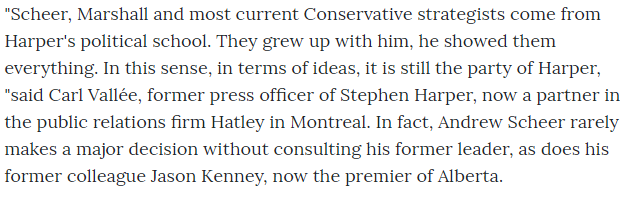
Jason Kenney and Scott Moe both have Harper on their provincial payrolls, directing their governments. And you can bet Scheer and whomever takes his place will have Harper on speed-dial looking for direction, advice, orders... 
Harper is still running the CPC. He may be relegated to being Oz, the man behind the curtain, but he is not done what he tried to do to Canada.


And so, given that Harper is still very much in play, and even if he wasn't, his acolytes still occupy most CPC seats, one might wonder what has precipitated this full-on barrage of made-up scandals directed at the Liberal Party. 
Well, the amending formula for the constitution requires 2/3 of the provinces representing at least 50% of the population, and senate approval, to agree to re-open the constitution, including the Charter of Rights and Freedoms. 
solon.org/Constitutions/….
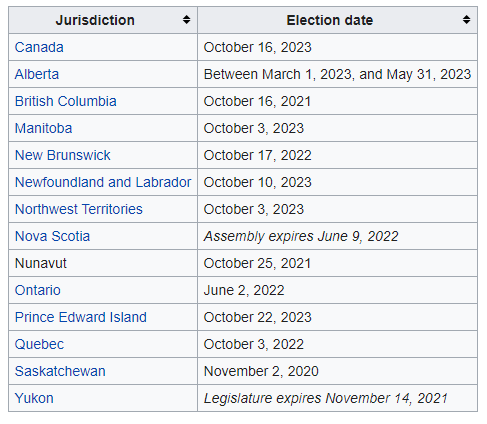
Right now, the conservatives control Alberta, Saskatchewan, Manitoba, Ontario, New Brunswick, and Prince Edward Island. And Quebec has shifted right and are amenable. There's there 2/3 of provinces and 50% of the population. 
en.wikipedia.org/wiki/Template:…
But Saskatchewan has an election coming up in November 2020. If, on the outside chance, the good folks of Saskatchewan decide they want a change of government, the perfect constellation allowing a re-opening of the constitution is gone. 
It is, I grant you, a slim chance. But the CPC are not about to let this opportunity slip away without a huge ugly fight. 
If they can get all the stars aligned, they can eradicate the Charter and change the constitution, so that none of their legislation can ever be overturned in the courts again. They will have absolute power. 
This is an ambition talked about in conservative circles. They want to offload federal responsibilities onto the provinces, create a "small" federal government, And be free to pass whatever laws they please without interference. 
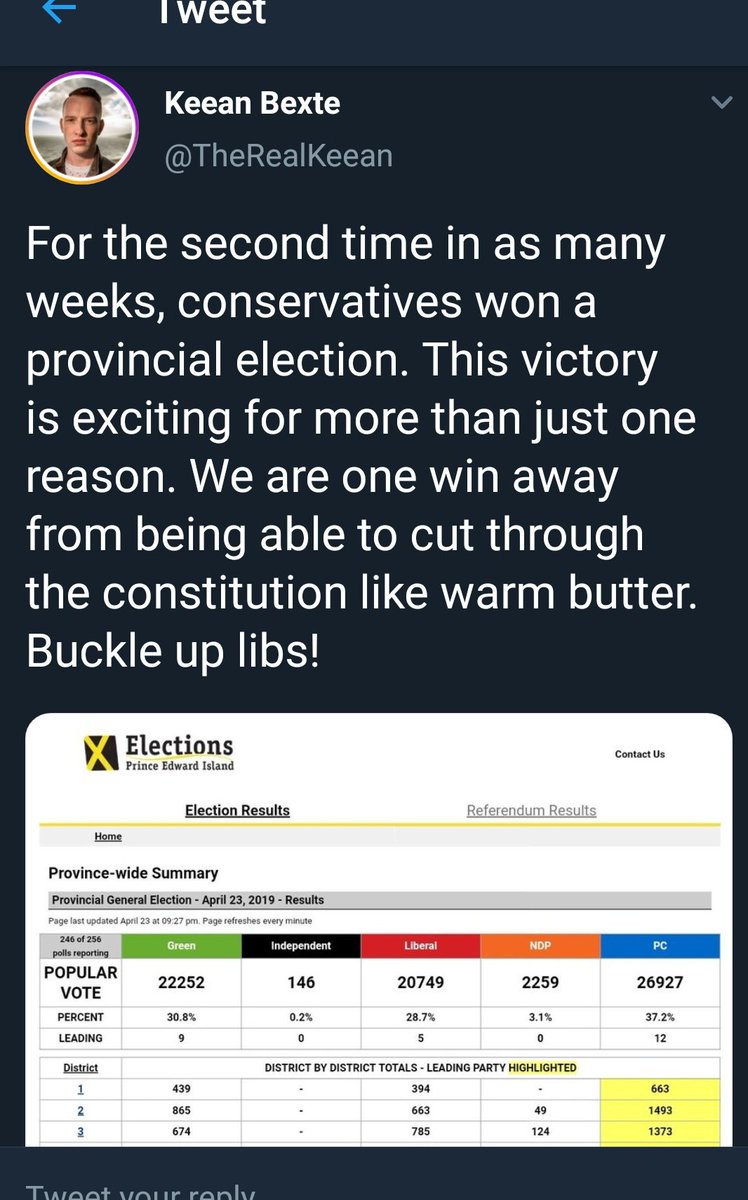
This is tantamount to completely rewriting what Canada is. People need to understand this. Without our constitution and charter as they stand now, many people will be vulnerable to having their rights stripped away. Universal health care would be in jeopardy. 
In short, if the CPC get what they want, if they can topple the Liberal government before they lose the necessary number of provinces to open the constitution and gut it, we are looking at becoming a clone of the US. 
He would dearly love to see us Americanized, as would his proteges in the CPC. And the UCP (Kenney, looking straight at YOU). 
Fortunately, I believe Canadians have a lot more sense than to vote for the CPC. We should be seeing now, from what is going on in Alberta and Ontario, and Manitoba, and the rest of the conservative led provinces, that they are not acting in our best interests. 
The public good is not a concept they extol. They are in it for themselves and the corporations who reward them. How do you suppose CPC MPs got so rich under Harper? Not from their salaries as MPs, that's for darned sure. 
The whole lot of them need to be audited, and then tossed to the curb. They are not here for us. This is not your grandparents' conservative party. This is an offshoot of the US Republican Party. Do not be confused. 
They want to remake Canada and not for the better. This is why they are so desperate to get into power before provincial governments change hands. 

Monday, 20 July 2020

What If... (Liberal "Scandals" May Be CPC Inventions)

So, here's a "what if..." Bear with me. What if the CBC is rife with employees hired during the reign of the Harper appointed board who are in place to pursue character assassination of any PM who is not CPC?

What if the RCMP is rife with conservatives who are reluctant to investigate conservative shenanigans like Jason Kenney's leadership campaign? I mean, yeah, they go through the motions for the optics, but stall and hope public interest fades away...

What if the former ethics commissioner, Mary Dawson, is a Harper loyalist who turned a blind eye on Harper's ethical shortcomings but has suddenly become a vocal critic of PMJT despite the obviously unprofessional and unethical position it puts her in?

What if some civil servants have a side mandate to undermine PMJT and the Liberal government and take advantage of opportunities to plant landmines like the photo of PMJT with Aspar Jatwal in India? Or the photo with Joshua Boyle?

What if the CRA is rife with CPC loyalists who continue to not investigate offshore wealth? What if the legal branch of the civil service is rife with CPC loyalists who keep taking Indigenous children and vets to court to obstruct appropriate funding to make the Liberals look bad?

What if the Saudi arms deal and the secret China deal that Harper signed have kept the current government hogtied despite public sentiment that urges a different response to these governments?

What if Harper loaded the deck so that anyone who succeeded him would face a shitload of problems, even without his puppets, Scheer and Poilievre, and his lackeys in the media, Fife, etc, continually trying to undermine and topple the government? Phoenix, anyone?

I'm just speculating here. But, things Stephen Harper was known for were holding a grudge and planning for contingencies. It seems pretty clear he felt he should have been PM for life.

What would he stop at in efforts to make life as miserable as possible for anyone who defeated him? At least 24 secret orders-in-council. More than any other government, even wartime governments. What did he do?

Harper had a decade to make changes in the civil service. To make it reflect his vision to some degree. Potentially to make it hostile, or at least uncooperative, to his successor. I am just encouraging people to look beyond the narrow view we are getting from MSM and the CPC.

And if you can totally embrace all the conspiracy tales that have been coming at us from MSM and the CPC, why do you feel what I am speculating about is so absurd? Does it have to do with your own biases and beliefs?

Why is it easier to believe that the Liberals are paying back WE for them occasionally hiring members of PMJT's family for speaking engagements in the past than to believe that 10 years of Harper led to some fundamental changes in how the civil service behaves?

The Trudeau speaking fees were not even high in the scope of speaking fees. Definitely not lucrative enough to throw away masses of political capital for. Misjudgment of the optics, maybe, but there does not seem to be any substantive evidence of malfeasance or bad motives.

Pierre Poilievre attempted to churn up a scandal about renovations that had been planned for years by the NCC, suggesting Trudeau was building himself a palace with public money. Think about that. The CPC assumes people don't know how things work


.
They make stuff up and throw it out there, trying to find something that will stick. Think about the source. If they tried to feed the public a fantasy about a secret palace, shouldn't all the "scandals" they rant about be put under a microscope? Think critically.

Here is some background to what I have been speaking about with respect to Harper "stacking the deck":


Friday, 21 June 2019

An Open Letter to Jason Kenney RE: Earplugs


Premier Kenney,

I did not vote for your UCP candidate. I do not like your platform or policies. Nevertheless, you are the Premier of Alberta and you won with a solid majority. Those of us with different points of view are, I believe, handling this with considerably more decorum than many very vocal conservative supporters after Rachel Notley and the NDP won the last election. As I recall, there were calls for a “kudatah”, along with many suggestions that our then Premier should be executed, along with her caucus.

You have a majority government. You can pass whatever legislation you want. Apparently, that is not enough for you. You feel the need to demean the opposition, and the Albertans they represent, while you do it.

Your stunt last night with the ear plugs was not “funny”. It clearly signalled that you, as leader of the government, were not interested in what the opposition (who also represent Albertans) had to say. The job of the opposition is to represent their constituents. One of the ways they do this is to consider the legislation you put forward and, if they feel it is necessary, point out problems with that legislation. Vehemently, if necessary.

Your job, and the job of your caucus, is to LISTEN. And to consider what they have to say. The purpose of this is that legislation is crafted which best represents the views of all Albertans, not just your supporters. That is how democracy works.

When you were elected you made a speech in which you said “We will strive to be a government for all Albertans, not just those who voted for us.”

Last night your actions said, “We have no interest in anyone who disagrees with us. We have no interest in Albertans who did not vote for us. We have no interest in working with the opposition to create legislation that is good for all Albertans. We don't want to hear the views of other Albertans. In fact, we refuse to hear their views.”

This is very disappointing, Mr. Kenney. We had hoped that you would be bigger than this.

I feel, along with many I have communicated with today, that you don't care about ALL Albertans, only the ones who see the world as you do. I feel that those who do not share your ideology are not welcome here anymore.

What you called just a bit of fun to lighten to mood is sending a clear signal. It is not signalling respect for others. It is not signalling that you value all Albertans, or see our ideas as equal. It is signalling that you do not want to hear any questions or disagreement. That there is no room for discussion on any of your ideas or plans. That those who do not share your vision are, from hereon in, disenfranchised in this province.

If you ever meant what you said, that you would strive to be a government for all Albertans, you failed last night. And this should concern all Albertans, even the ones that voted for your party. Because there may come a time when they may not agree with you. And you have now made it clear you don't want any disagreement.

That isn't how a democracy works, Mr. Kenney. Only allowing one point of view is a different form of government. It is called a dictatorship. So much for that “grassroots guarantee”. But that was only to get votes, right?

Last night you demonstrated clearly who you are and how Albertans who disagree with you should expect to be treated.

I am very disappointed. But not very surprised.


Monday, 1 April 2019

Integrity and Alberta Politics - Should a Cheater Win? - Alberta Votes 2019, part 3 (part 2, revised)

There's an old adage, "Cheaters never win." It likely exists to discourage people from cheating, suggesting karma will get them, or their misdeeds will ultimately revealed. But in this 2019 election, we have one party running whose leader and/or campaign team may very well have cheated their way to control of the largest conservative party, the UCP. 

The allegations brought forward by those in the know are that:

a) Kenney and his team set up a "Kamikaze" or dark horse candidate. This candidate was to attack Kenney's primary rival, Brian Jean, saying things that Kenney, himself, could not during the leadership campaign without appearing to be too nasty. Then the kamikaze candidate would withdraw from the race and throw his support behind Kenney. The Kenney team provided speaking notes, advertising materials, etc. for this opposing candidate.

b) This candidate, Jeff Calloway, needed funding to run for the leadership and this funding was arranged through "irregular" means.

c) Not content with surreptitiously undermining his main opponent, it is alleged that Kenney's team sold many, many memberships to people. Then, instead of submitting these memberships with real emails attached, offshore servers were used to generate email addresses that would be under the control of team Kenney. Many members complained they had not received their codes for voting in the online leadership race. Allegedly, this was because the codes were sent to team Kenney, who then operated kiosks in warehouses to process votes for Kenney using VPN technology (this hides a computers real identity and subverts the coding which prevents multiple votes from a single person), racking up Kenney's vote count.

CBC News searched for registration data using DomainTools and confirmed that dozens of email addresses attached to UCP members were all purchased by anonymous sources in the lead-up to the UCP leadership vote, between Sept. 20 and Oct. 13, 2017.

Albertans have been overwhelmed this past week with a deluge of controversy and scandal from the UCP. With candidates dropping out because of racist, transphobic, and misogynist views, the return of proposed legislation to out LGBTQ kids in school GSAs, impossible promises to "opt out" of equalization payments, and so on, some may have lost sight of the first big scandal.

It strongly appears that Jason Kenney cheated in the leadership election back in 2017. Not just in one way, the identity theft and fake votes, but also with the kamikaze campaign of Jeff Callaway. And the question remains, can someone who cheated to become leader of a party then become Premier of the province?

Some will say that he would have won anyway, that the cheating only increased the margin of his win. But that's not really the point, is it? Shouldn't our elected officials be held to a very high level of integrity? Shouldn't being a cheat disqualify someone from holding such an important office?

I know, the investigation is still underway. And it likely will not conclude before the election. Also, Kenney has been at this political game a long time. It's all he's ever really done. He learned from Harper. He no doubt has plausible deniability built into this scenario. He will say, if it is proven that these acts of cheating happened, that he didn't know. That it was over-zealous campaign staffers. That no one told him.

But just as it was impossible for thinking people to believe that a micromanaging control freak like Harper had no idea about Nigel Wright paying off Mike Duffy's fines, it is impossible to imagine Kenney had no clue of all the machinations that seem to have gone on in the leadership race.

I referred to politics as a game. But it is not. Some politicians conduct themselves as though it was, but their actions have very real consequences for real people. If Kenney wins and changes the rules about GSAs, it is almost certain kids will suffer. Some will probably die. If Kenney makes health care less accessible to the poor, people will suffer. Some may die, and some may go into crushing debt. If the UCP wins and rolls back worker and consumer protection, people will suffer. Some may die. If the UCP wins and cuts the environmental programs in Alberta, everyone will suffer.

It's not a game. And we need to be very, very careful when we choose the party that will form the next government of Alberta.


Friday, 3 February 2017

The Quagmire of Electoral Reform in Canada

In 2015, Liberal leader Justin Trudeau said this would be the last election under the broken first-past-the-post system in Canada. Now, in February, 2017, he says nothing is going to change in our electoral system. This is deeply frustrating to those who fervently want to see a system where they can feel that their vote counts, and they have representation in government. This feeling seems to be primarily based in places where progressives find that their riding will always elect a Conservative, thus leaving them unrepresented. Conservatives in progressive ridings probably feel similarly put out when they can't get their preferred party's candidate elected. However, the official CPC line has been opposed to electoral reform. It is seen as a huge threat because if you never get much more than 30% of the vote nationally, the progressive vote must be split in just the right way between the other parties for you to form a government. That is under f-p-t-p, but if any of the other proposed systems were implemented, it would be almost impossible, without a radical shift in the Canadian zeitgeist, for the CPC to gain power.

Referendum

To combat any change, the CPC called out loudly for a national referendum, knowing full well that such referenda are terrible tools for forming policy. The entire concept is unwieldy, for one thing. To effectively hold a meaningful referendum, the entire population would have to be educated on all of the possible new systems. Here is one attempt to clarify the different systems and how they would work. While it is not really all that complicated, it seems not enough Canadians actually care enough about the electoral process to learn, evaluate, and form an opinion. Only if we all learn and understand could a referendum be remotely meaningful. In ignorance, many people would vote the way their favourite party directed them to vote, or simply not bother to vote at all.

To add to this, there would be diverse and conflicting information about the impact any different system would have on our country. Some would be educated and measured, but some would border on the hysterical. I imagine the CPC would send out their usual biased polls: "Would you vote to keep our well-functioning electoral system as it is, and as it has served Canadians well for 150 years, or would you vote for an untested and more complicated system that could have dire ramifications for the Canadian way of life?" And then ask for money to help them fight this unnecessary, unwanted, and expensive change to Canada.

The CPC undoubtedly knew that the task of educating the general public would be onerous. They knew there is a natural tendency, when dealing with complicated issues, for people to go with the status quo. And with their mighty war chests, they can afford to put on a huge campaign in favour of voting against change. They possibly also felt that if the government's position was defeated in a referendum, this would be a launching point for a vote of no confidence. The Liberal government was, no doubt, also aware of these pitfalls.

The Hornet's Nest

I expect that before the election, Trudeau and his advisors did not realise what a hornet's nest this issue could be. They put themselves in a "damned if you do, damned if you don't" situation. If they changed the electoral model, the CPC and NDP would scream that they only did it to ensure they keep winning every election. The Liberals favoured one model, the NDP another, and the CPC wants FPTP. So no one would ever reach a consensus on what to do. If the Liberals brought in their preferred electoral system, the other parties would talk loudly about dictatorial government, changing this fundamental thing without a plebicite. On the progressive side, there is the strongly held opinion that the last election was, essentially, a referendum on this issue.

By withdrawing from electoral reform, the Liberals now have the other parties screaming that Trudeau broke his promise. Never mind that the CPC got exactly what they wanted all along. Are they happy? No. Of course not.

The Real Problem (s)

Our political system is set up to be adversarial. It's like people cheering on their favourite sports teams. Each party has a philosophy, it's true. But each party (and their followers) have even bigger egos. If one party puts forward an idea, any idea, the other parties will knock it down. Not because it would be bad for the country, but because the other party thought of it.  Governing should not be about power, or revenge, or ideology.  Governing should be doing what is best and right for the country. Governing should be working together with those who have different ideas to reach mutually acceptable policies that improve life for all Canadians. We have seen in the US what an intractable opposition party can do to suspend government's work. The GOP shut down the government there when they didn't get their own way.

Elizabeth May, leader of the Green Party of Canada, sometimes comments wistfully about a time when she first began working in public service, when consultation and co-operation were a major part of policy development. Government members would meet informally with members of the opposition parties and discuss how to create policies that all sides could support, in the interest of the country. And that is how it should work. Not everyone would get exactly what they wanted but significant issues would be addressed with reasonable accommodation. Surely that is better than a small group getting whatever they want and everyone else being unhappy.

The adversarial nature of politics in this country has been developing over a long time. It did not start with Stephen Harper, although he did push the "my way or the highway" approach to governance well along. The US is now further down that path, and no doubt Donald Trump will push it much further. While Harper was careful to not push too far too fast, Trump clearly is out of control and does whatever comes into his head, refusing advice from anyone except a small coterie of the like-minded.

Some form of proportional representation would force greater consultation and co-operation, potentially heading off any reprise of a Harper-style or Trump-style government in the future. Much like in a minority government, no one party would have sufficient power to force through unpopular legislation.  Some have worried that such a system would allow "fringe" parties too much voice and the entire legislative machine would bog down in attending to minutiae. This seems unlikely, as fringe parties are just that. If many people voted for them, they would be mainstream parties.

Ultimately, in an ideal system, MPs would be elected to represent their constituents' interests, rather than toe a party line. Like many Canadians, I have no representation in Parliament by the MP for my riding. He is CPC and I feel he would sooner spit on me than listen to what I think about things. He has been spectacularly unresponsive to letters I have written, and appears to vote with the party on all issues. Eventually, one is inclined to give up and be resigned to having no voice in Ottawa. And I believe a lot of Canadians, of every political stripe, have encountered these feelings. If we are to have a truly representative democracy, all people must be represented.

Which brings us back to the mechanics of making such a change, and why it failed.

There is the non-co-operation of those from the various parties who were tasked with coming up with a plan. CPC said no reform. NDP wanted mixed member proportional representation. Liberals wanted preferential ballot proportional representation. Stalemate.

Then there are Canadians, ourselves. Did we drop the ball when we were asked for our opinions? Did we fail to make the government and our opposition MPs see that we really want this? Or do enough Canadians want the old system to quash the idea? This analysis of the data gathered from MyDemocracy.ca seems to suggest otherwise. If, as the article says, about 80% of Canadians believe democracy in Canada could be improved, why has this fallen from the government's legislative plans? More importantly, what can Canadians who care do about it?

Given that a referendum would be a horribly divisive and unwieldy process, how can we let Justin Trudeau know that we are not pleased with his decision? For starters, we can write letters. Both to him and to our local MPs, however unrepresentative they may be. Being deluged with mail, especially real physical mail, has been known to shift political plans in the past. You can find contact information for your MP right here, just by entering your postal code. And remember, letters addressed to the House of Commons do not require postage.

You can also get involved with a group like Fair Vote Canada and see what events and actions are planned near where you live. You can sign the online petition at Lead Now Canada (either the primary national petition, or there are several set up now that are specific to a region or riding, or sign both!)

You can also give the government an earful here. They are asking for our opinions about what they are doing. So, tell them, already!

This is our country and our democracy. We have a responsibility to speak up when we are not happy with the direction our government takes. Bitching and moaning on FaceBook and Twitter doesn't help. Speaking directly to our MPs might.