Showing posts with label #guncontrol. Show all posts

Saturday, 2 May 2020

The Overton Window and the CPC

I mention the Overton Window in the title of this blog and it is important to understand this concept to follow what comes later. Here is an American explainer video. Remember that in US politics the colours are reversed. Red is conservative, blue is progressive. Here is an explanation from the Canadian perspective. 

On May 1, 2020, CPC MP Pierre Poilievre posted this, suggesting that the Liberal government's banning of military-style firearms in Canada is a far-left move.


To clarify, there is very little "far-left ideology" present in Canadian politics. The Communist Party of Canada (the original CPC) has elected exactly 1 MP, in 1945.

The CCF (later NDP) was/is? a party based on social democratic values which include universal healthcare, the right for workers to organise to have the power to enter into negotiations with employers to ensure a living wage and safe work conditions, equal opportunities for all children to receive a good education, universal suffrage (every adult gets a vote), and inclusiveness of all people, regardless of gender, race, religion, sexual orientation, etc. There is also a strong belief in a safe and well-governed society, which includes restrictions on activities which are not in the public good or which adversely affect public safety. Things like gun control, banning drunk driving, encouraging the use of seatbelts and car seats and motorcycle helmets, and banning substances like asbestos that make people gravely ill.

Social democratic principles are supported by many Canadians. However, there is a long-standing campaign from the right to equate the CCF/NDP with communism. They would have you believe that support for the NDP is support for bread lines and confiscation of personal property and multiple families forced to live together in drab grey Soviet-style apartment complexes. They maintain that the NDP support Maoist re-education camps and internment of political dissidents.

This is a load of codswallop.

Social democratic principles are about raising everyone in society to have a good standard of living. It is opposed to the accumulation of vast wealth and huge wealth inequalities. In other words, social democratic principles would see the rich taxed fairly and crack down on wealth-hiding, and make corporations pay their fair share.

It should already be clear why those on the right hate this way of thinking so much.

Social democratic principles are humanist principles. They put human beings before profit. This is a sharp contrast with the right, particularly those in the US who are outright declaring that they are ok with thousands of people dying from COVID-19 in order to get the stock market back up.

A Bit of History

In the past, there were more similarities than differences between the Conservatives and the Liberals. Both were very accommodating to big business. Both were fairly hard on the poor, people of colour, LGBTQ+ individuals, etc. The Conservatives were a bit right of centre, the Liberals were a bit left of centre.  This is why the old saw "Liberal, Tory, same old story" was very popular with people who did not like others encouraging people to vote. It minimised the differences between the parties.

Things began to change while Pierre Elliot Trudeau was Prime Minister. The elder Trudeau was more of a humanist, believing that government had "no place in the bedrooms of the nation" and repealing laws that discriminated against the LGBTQ2+ community.

The change really jumped into high gear when Stephen Harper and his Reform Party (led at the time by Preston Manning) came on the scene.

"The Reform Party called for the privatization of various government services that the party believed could be better provided by the private sector. These government services included a number of state-owned corporations including Canada Post, the Canadian Broadcasting Corporation, and Petro Canada. The Reform Party suggested that Canada's government-funded universal health insurance system be replaced by a two-tier private and public health insurance system. Preston Manning asserted however that the Reform Party was committed to ensuring that all Canadians would be able to access health insurance and health services."The Reform Party called for major changes in the federal government's relations with Aboriginal peoples, which included dismantling the Department of Indian Affairs and transferring its responsibilities directly to Aboriginal governing bodies to lessen Aboriginal peoples' dependence on the federal government.(In other words, they wanted out of the treaties)
The Reform Party strongly opposed extending marriage rights to gays and lesbians. Many members of the Reform Party saw homosexuality as a moral wrong. Reform leader Preston Manning himself once publicly stated that "homosexuality is destructive to the individual, and in the long run, society".
The party was also known to have suggested a potential return to capital punishment, the only party in Canada to have done so.

The Reform Party advocated an immigration policy based solely on the economic needs of Canada.[28] Reform's early policy proposals for immigration were seen as highly controversial in Canada including a policy pamphlet called Blue Sheet that was issued in mid-1991 stating that Reformers opposed "any immigration based on race or creed or designed to radically or suddenly alter the ethnic makeup of Canada".[29] The statement was considered too controversial and subsequent Reform Party policy documents did not declare any similar concern for a radical alteration of the ethnic make-up of Canada.[30] However this controversy and others raised the question over whether Reform was intolerant to non-white people and whether the party harboured racist members.[30] Subsequent repeated accounts of xenophobic and racist statements by individual Reform party supporters and members spread this concern, though the party itself continuously denied that it supported such views.[25]
The Reform Party declared its opposition to existing government-funded and sponsored bilingualism and multiculturalism.[30] Reformers claimed that efforts to create a bilingual country had not worked and that language policy should be a provincial issue. Reformers criticized government-sponsored multiculturalism for creating a "hyphenated Canadian" identity, rather than a single Canadian identity.[31]

The Reform Party was founded as a western-based populist party to promote reform of democratic institutions. However, shortly after the 1987 founding convention, social and fiscal conservatives became dominant within the party, moving it to the right. Their political aims were a reduction in government spending on social programs, and reductions in taxation. Though largely a fringe party in 1987, by 1990 the party had made huge inroads in public support as support for Mulroney's PC party dropped due to the unpopular Goods and Services Tax (GST), high unemployment, and the failure of the Meech Lake Accord. In 1992, leader Preston Manning released a book called The New Canada explaining the origins of the new party and its policies, explaining his personal life and convictions, and defending some of the controversial elements of Reform's policies. (from Wikipedia)

Then they became the Canadian Alliance Party and went from a western-based party to a national party. In 2003 the Canadian Alliance Party and the Progressive Conservative Party merged, thanks to Peter MacKay (yes, the one who is now trying to lead the CPC). MacKay sold out the Progressive Conservative Party and allowed the Reform/Canadian Alliance Party to take over, driving out many "Red Tories".

Enter Stephen Joseph Harper. Harper was one of the founding members of the Reform Party. He went on to head the National Citizens Coalition, an entity created in 1967 for the express purpose of dismantling the then brand-new Canada Health Act which guaranteed health care to all Canadians regardless of ability to pay.  This is a core value Harper has brought with him from one organisation to another.

In 2003 he became the first leader of the Conservative Party of Canada (CPC) which emerged from the merger of the Canadian Alliance and the PCs. As soon as Harper became Leader of the Official Opposition in Ottawa, Stephen Harper began to work to shift Canada to the right. He used language to try to change the way Canadians view the world. He and his party talked about "special interest groups" and "environmentalists" in a pejorative fashion. He vilified "Big Union Bosses" and "activist judges". He encouraged Canadians to think with their guts and ignore "academic elites", i.e. experts who have been highly educated and devoted their careers to learning all they can about a particular subject. He employed methodology laid out by Arthur Finkelstein, the communications guru who helped to get 3 US Republican Presidents elected as well as Israeli Prime Minister Benjamin Netanyahu. The CPC have been in continual campaign mode and attack mode since their inception, lowering the bar on advertising and political dialogue to hateful and often misleading levels. Most importantly, Harper worked hard at making "Liberal" a dirty word.

Harper was PM for almost a decade. The dark ages as some of us like to call it. Here is something of a list of the things he did while PM, including destroying research libraries, eliminating the long form census, ignoring Canadians in trouble abroad if they were non-white, ignoring First Nations issues, and opening the door to provincial governments to bring in two-tiered health care.

Current Situation

The CPC has moved far to the right of the old PCs. People used to say that both parties want what is good for Canadians, they just have different ideas of how to get there. This is no longer true, but many people have not yet realised it. Indeed, Stephen Harper's disdain for Canada and Canadians is well documented. 

The CPC, now led by Andrew Scheer, continues to push to normalize things that would have been widely condemned as heartless, cruel and un-Canadian before 2003. He and his party support loosening, not tightening gun laws. They support making university funding contingent on allowing far right speakers at least an equal platform on university campuses. They are heavily funded and supported by anti-abortion groups and would, if in power, seek to ban abortions eventually. They would follow in Stephen Harper's footsteps and expand draconian sentencing that disproportionately harms vulnerable people and members of minorities, possibly with an eye to opening up Canada for American prison industrial complex business. The CPC are vigorously anti-union and anti-worker. The CPC support home schooling and private religious education while endorsing cuts to public education.

So, the CPC is further to the right than the old PC Party ever was. The Liberals, under Prime Minister Justin Trudeau, are somewhat further to the left of previous Liberal parties, embracing a humanist approach that coincides with a general shift in Canadian society that has been going on since the 1960s. But the CPC, with the help of much of the Canadian media, has been pushing hard to make centre look left, and left of centre look extremist.

And yet, a vast majority of Canadians support the new gun ban. Despite all the hard work by the CPC to try to make us meaner and greedier and more self-centred, Canadians still care about others.

Source: Angus Reid

So, no, Mr. Poilievre, this is not far-left policy. This is in line with what most Canadians want. And it was part of the Liberal campaign platform in 2019, so it is not just a reactionary response to the Nova Scotia mass shooting.


Wednesday, 7 August 2019

What I Learned From Twitter

A few days ago, in the wake of two mass shootings in the US, one in El Paso, Texas, and the other in Dayton, Ohio, I posted a tweet thread about my fears that a CPC win would see more guns and more military style guns coming into the hands of Canadians. This fear is based on CPC leader, Andrew Scheer's platform which was online during his bid to become leader of the CPC. The platform was pulled down the next day. The supposition is this was done because what is palatable to the CPC membership may not be palatable to the rest of Canadians.

In his section on guns, he promises to take away RCMP powers to designate certain weapons as restricted or banned. He promises to repeal restrictions on magazines, which are currently set at a maximum of 5 rounds. He said he will put representatives of the gun associations, the NFA and the CCFR and possibly others, on the Firearms Advisory Council, a body which was formed to advise government on gun regulations. The Council currently has citizen gun owners on it, along with representatives of the police, the judiciary, women's groups, and members of the health-care community. The current composition of the Council emphasises public safety as the goal of gun legislation.

Scheer also promised to. essentially, forgive gun owners who do not renew their permits on time.

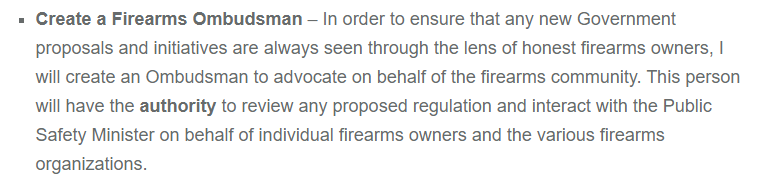
Finally, Scheer says he will create a Firearms Ombudsman, whose role it would be to ensure that all legislation is seen through the lens of the firearms community.

He goes on to say that "law-abiding Canadians should not have to justify to the government why they need a firearm." An important thing to note is the two gun organisations noted above have ties to the NRA and both advocate for laws that allow the use of guns for the defence of person or property. This is a radical shift in philosophy from what has been prevalent in Canada. The emphasis under Scheer would be keeping gun owners happy, rather than keeping the public safe. My analysis of this and some info on the gun organisations that will apparently be running the show is here.

So I posted this. I began my thread with a rather gory picture which I understood was a shot of a trauma room after a gunshot victim had been treated. There was a bed, empty, and a lot of blood on the sheets and the floor. Medical equipment and a couple of nurses could be seen in the background. You can see a blog version of my tweet thread here.

Definitely not the most diplomatic way to approach the subject, I admit. But on Twitter, sometimes you have to SHOUT to get people's attention. I got attention, alright. Now, several days later, several hundred a day are showing up to beak at me. Better than the thousand or so a day for a couple of days after I first posted it.

I got people's attention. There were quite a number of people who agreed with what I was saying. But there was also a storm of people who were outraged. I was able to observe several things from this.

1) Many people have very poor reading comprehension skills. It didn't seem to matter how I tried to explain what I was talking about, they just didn't get it. They would say things like, "Canada's gun laws are perfectly adequate. What are you talking about?" - completely missing the point I was making that a CPC government would change Canada's gun laws to be less than adequate.

2) Many people do not know how to interpret messages or read between the lines. Ever so many demanded to know where Scheer had said he would let more guns into Canada, where is the video or the citation for a quote?... And no matter how I tried to explain that while he is obviously not going to come out and say that word for word, one only needs to read his platform to realise that is what he means. The very fact that he has a gun platform, while barely giving a nod to climate change, is a good indication of where his priorities lie.

3) Several people were determined to prove the photo was staged or fake. This really puzzled me. We are talking about gun violence and gun proliferation and you are trying to prove that it can't be a real photo because the blood is too red? Really? Why? Were they squeamish? Did the message lead to such cognitive dissonance that they sought to find falsehood in the image so that they could dismiss the rest without thinking about it? Incidentally, there were responses from several ER/trauma doctors and nurses who said, yes, this is exactly what it looks like and I see it way too often at work.

4) Some expressed the opinion that getting rid of guns was not the answer. Longer, harsher sentences for gun crime was the answer. Tapping into that right-wing thirst for vengeance, rather than seeking solutions and preventative measures.To which I say, that is the wrong paradigm. In a mass shooting, even if the perpetrator doesn't die in the process, the victims will still be dead or maimed, no matter what sort of sentence is imposed. It's shutting the barn door after the horses have bolted. We need prevention. That means getting guns off our streets and curbing the ownership of potential weapons of mass destruction, even among "responsible, law-abiding gun owners" because guns get stolen. Guns get sold quietly. Responsible, law-abiding gun owners are responsible and law-abiding until they aren't. Many guns used in US mass shootings were obtained legally or "borrowed" from friends or family members. It also means combating the root causes of gang membership and violent crime. These include poverty, alienation, lack of access to quality education, violence in the home, and exposure to radicalising right-wing, white supremacist propaganda. The US has among the harshest "tough on crime" laws in the developed world, and the highest rate of multiple homicides. Longer sentences are not a deterrent. Especially if the perpetrator doesn't expect to survive their moment of glory. The CPC plan is to go the US route. When the only tool you recognise is a hammer, everything looks like a nail.

5) Most who disagreed were insulting. They called me a "retard", a "liar", "scum", a "diseased toxic liar", and worse. They said I had no compassion or conscience. They called me a "Liberal shill", a "libtard", and  "lefty turd". They said it was horse crap, and fear-mongering, and using a tragedy to score cheap political points. Is it fear-mongering when there is a real danger and someone tries to warn everyone about it? I did not advocate for any political party, simply warned that loosening gun laws is in the CPC platform. If we don't want to become like the US, we should not vote in a CPC government.

6) Most attackers were conservative, either supporters of the CPC or the PPC. Almost all, in fact. Many have very few followers which, I am told, makes it likely they are paid trolls or bots. A few were also extremely religious. None offered anything to convince me that what I presented was wrong, other than "He never said that!" which they repeated even after being shown where and how he did say it.

7) Further to the inability to evidentially refute my premise, being presented with information that conflicts with what they believe seems to fill many with rage. There is no room in the ardent CPC supporter's mind to examine any evidence that does not fit their world view. It is a very curious phenomenon. Some might call it willful ignorance.

8) Some offered the argument that it didn't really matter what the CPC did because guns were already easy to get. One person who responded said it doesn't matter what they do with the 5 round magazine limit. It's totally easy to knock the limiter pin out. All you need is a power drill. I offered the suggestion that he had maybe just admitted using his firearms in contravention of the Criminal Code of Canada. He went silent.

Anyway, I am not bothered by their words. I have been called worse by opponents on the ice, holding a big stick and standing right in front of me. What I hear is, "I am a conservative. I have always been a conservative. I believe in the conservatives and anything they want to do is just fine. I will not listen to any other view. I will get very angry and abusive and try to silence other views. Because my leader, Andrew Scheer tells me that the other parties, especially the Liberals, are evil and destroying Canada and the economy and they lie all the time. Only Andrew Scheer and the CPC can be trusted to tell me the truth. Not most of the TV stations and not most of the newspapers. Andrew Scheer never said any of this, and if he did, he must have a good reason." And that is quite troubling.

However, it is generally understood that between 28% and 33% of Canadians will always vote "conservative", regardless of what the party is called or what they do. And they always vote. And if a conservative party is in power and does things that make these conservative voters' lives miserable, they will still love them. They will blame another party, or immigrants, or someone that isn't them. They are, as seen by the replies in my Twitter feed, so indoctrinated it seems impossible to reach them. Voters for other parties switch party from time to time, depending on how their current party of choice is behaving and what they are offering in the way of policy. Also, in recent years, which candidate in their riding can potentially keep a seat away from a CPC candidate.

The challenge, then, is to make sure those who are not voting conservative recognise that the threat from a CPC government is very real. That preventing CPC candidates from being elected at the riding level, outweighs any misgivings one may have about one party or another. If we do a very good job of this, the CPC could be reduced to third party status, with some constellation of Liberal/NDP/Green actually governing the country.

This is, of course, conservatives' worst nightmare.

From a sociological point of view, it is quite fascinating. There is this subset of the population that is quite anomalous to the mainstream Canadian zeitgeist. Their views are more American than Canadian. For this, I hold the inundation of Canada by American media at least partly responsible. An alarming number of Canadians don't realise that gun ownership is not a "right" in Canada. It is a privilege. They don't have any sort of clear grasp of how our systems of government work. They refer to DAs instead of "the Crown prosecutor". They want to "impeach" Trudeau. They think they can petition to recall elected members of legislatures or parliament. For this I also blame a substantial dearth of civics education, taught in an engaging and meaningful manner, throughout the K-12 school experience of Canadian children.

It is impossible to know, interacting with them online, if you are dealing with a bot or paid troll, or someone who is very low information, or someone who gets all their information from the CPC and the Rebel and The Sun newspapers. Or if they are so indoctrinated they can't comprehend any views or evidence that differs from their own views. Or if they just really can't, for whatever reason, cope with changing their opinion about anything, and so dismiss or fight against any challenge to their closely held views... I hesitate to say they are very nasty and irrational people, although they frequently present as such online. Presumably there are people in their lives they are kind and generous and compassionate towards. Wouldn't know it from their online presence, but, whatever.

So, that's what I learned from Twitter over the past few days.

Monday, 5 August 2019

Andrew Scheer's Plan for Gun Laws in Canada

It needs to be understood, and I believe it is not understood widely enough, that politicians who plan to do controversial things seldom spell them out in plain language. They say them, so supporters who have donated money to get their interests on the agenda know that they didn't waste their money. But they don't say them outright. It is important for citizens to learn how to parse political speak so as to better understand what to expect from each party or candidate.

Doug Ford didn't campaign on cutting support for children with autism, did he? He didn't say, "if elected I promise to slash OSAP", did he? No. He said he would find "efficiencies". I have no idea what voters thought that meant, but, here we are.

Andrew Scheer isn't going to say on the public record that he is going to remove or reduce many of our gun control laws. Not in those exact words, anyway. Further on we will parse his policy statement which was on his website while he was running to be leader of the CPC, but which was removed the day after he secured the leadership. But first, let's look at some groups he considers "major stakeholders" in this issue.

 First, the National Firearms Association (NFA).

The mission of the NFA is as follows:


It must be noted at this point, to avoid any confusion, that gun ownership in Canada is not a constitutional right, as it is in the US. It is a privilege. This is an important distinction.

The NFA has a legal support program to help gun owners accused of breaking gun-related laws.


The NFA acknowledges its political activism for fighting what its members consider bad gun laws:


And the NFA is recruiting new members, using an enrollment contest with guns as prizes.


The NRA is prevented legally from giving funds to the NFA, but it offers assistance in others ways; logistical and tactical support, advice, etc.

The NRA and the NFA share the view that restricting guns will do nothing to reduce the number of gun homicides or mass shootings.

Next, the Canadian Coalition for Firearm Rights (CCFR):

They also have a mission statement:


They also have a vision:


Again, they view firearms ownership as a right, which it is not under Canadian law.

As you may have noted in the vision, the CCFR is quite interested in "human rights", i.e. the right to defend one's person or property. Canada's charter of rights and freedoms and our laws allow for the use of reasonable force. If you read the memorandum of the CCFR on self-defense, you may note the CCFR advocates for a shift to lethal force somewhat before our courts have deemed such an action "reasonable".


Likewise, the CCFR has a policy memorandum on concealed or open carry that is closer to the American rules than what is currently allowed in Canada.


The CCFR vision for the transportation of firearms also is more American than Canadian. They advocate keeping firearms locked in the trunk if you are not in the vehicle. If you don't have a trunk, they urge placing guns somewhere they cannot be seen from outside the vehicle.

As for storage, they want a change in the laws that would allow people to keep a loaded gun outside of the currently required gun safe for personal protection. Current legislation requires keeping firearms locked in a gun safe, and ammunition stored separately.

Not surprisingly, the CCFR has an opinion about magazine restrictions.

Also, not surprisingly, the CCFR would like to see magazine limitations removed. They go to some length to argue that it is pointless because criminals will subvert the limiting mechanisms anyway.

The CCFR was also running a contest this summer. Entries were based on giving a $25 donation.


There are other groups and media outlets devoted to making guns more accessible. There's the online site canadianguns.com and the Canadian Access to Firearms media outlet, just to name two.

Now let's parse Andrew Scheer's policy on guns, now that we are a bit familiar with some of the players. He calls this "Common Sense on Firearms" and you can find it here.

The preamble is all back-slapping "I'm one of the boys" stuff. He talks about how he "dropped a buck from 400 metres away".  This is a nod and a wink to gun-owners and hunters. He's saying he's one of them. He gets going out into the woods and killing animals for fun. No namby-pamby city boy here. No sirree!

The we get to the meat of the thing. He has an overview followed by 7 points.

Here he is saying he is going to do what the gun organisation say they want done on their web sites, a repeal of all firearms regulations that do not respect the rights of firearms owners. There is no mention of ensuring public safety. Zip. Nil. Nada. What he doesn't say speaks volumes.

The he gets into detail.


Scheer uses of the word "arbitrarily" which suggests the RCMP get all cross from time to time and classify a firearm as restricted just because they can. I seriously doubt that is how it works. I expect the RCMP takes data from front line officers' encounters with guns, looks at the capabilities of different kinds of guns, maintains a record of firearms seizures which gives some indication of what kinds of guns are becoming more common, and draws on the experience of police departments around the world. On the basis of this evidence, they may, from time to time, flag a type of firearm as a threat to public safety.

It is actually insulting to the firearms experts at the RCMP to say they ban guns on the basis of aesthetics.


Actually, the existing legislation does this already. For example:


This is a red herring aimed at low information voters who believe the Canadian government is keeping them from having a cool-looking gun because it's cool-looking. This is similar to Scheer promising the other day to increase health transfers to the provinces by 3% per year. People who didn't know that the Liberal government's commitment was already much higher got excited about this. In reality it is a $1.5 Billion per year cut to health transfers based on the current formula. This is who Scheer and the CPC are.


Scheer says he will replace the current legislation which says any large-round magazine must be altered to limit the number of rounds to 5. He says later on that he will take the advice of the firearm associations in forming the new legislation. Do you imagine for a moment that the CFA or CCFR are going to recommend lowering the number of rounds below 5? No, they will recommend not limiting the rounds at all. Go back and read the CCFR policy memorandum if you are unsure.


The use of the word "submit" is used to suggest a Canadian government who would go along with this is weak. The UN firearms protocol is designed to curb the illegal international arms trade. Can we all agree that the illegal arms trade is a bad thing? It is hard to fathom why the conservatives are so opposed. Scheer seems particularly opposed to the marking of guns by manufacturers and importers so that they can be identified and traced back through their history should they be used in a crime. If conservatives are all about catching criminals, why is this a bad thing? Is the fear that someone who stored guns illegally (i.e. not secured) was robbed and their guns were stolen then used in a crime or sold and used in a crime? Are they concerned that "responsible, law-abiding gun owners" might get in trouble for a) not storing their guns properly or b) not reporting the theft to the police because they didn't want to get into trouble for a)? If they aren't storing their guns properly, they aren't really responsible, law-abiding gun owners, are they?

Several countries and regions have been implementing the UN Firearms protocol. The programs are too new for definitive conclusions on effectiveness, but data is being gathered and outcomes will be assessed when enough data has been gathered.


Scheer has said he will strengthen the Firearms Advisory Council. The current council is comprised thus:

"The Committee consists of 10 members. Membership includes law enforcement officers, public health advocates, representatives from women’s groups, civilian firearms users, gun control advocates and members of the legal community. Members are appointed by the Minister for a maximum of two years."

The current composition reflects an emphasis on public safety, while including civilian firearm users. Scheer would remodel this council to allow the NFA and the CCFR and possibly other firearm owners rights groups more say in the decisions of the council. There are many questions raised by this. Would he maintain the committee size of 10? If so, who would be removed to make room for the gun association representatives? Or would he expand the committee to create new seats for the gun owners associations? Would such a large committee become unwieldy?


 Do these gun owners have problem renewing their driver's licences on time? Or car insurance? What about renewing their mortgage? Renewing their fishing or hunting licences? Dog licences? Life is full of things we have to do and some of them we only have to do once a year. Most of us manage. This sounds like Scheer would be excusing non-renewals, so why would people bother renewing? A better solution might be to send out email reminders and make it possible to renew online, just as they do with driver's licences in some provinces. What Andrew Scheer is proposing sounds like a slippery slope to no licencing.


Here he is saying that all new gun laws in the future will have to be in accordance with the wishes of gun owners and gun associations. He is shifting the focus from public safety to the "rights" of gun owners. This is a profound change that he is proposing. In light of what we see south of our border and sometimes in our own cities, public safety should be the number one concern.

I understand that First Nations and Inuit and Metis who live a lifestyle based on subsistence hunting need to be able to access firearms. I understand how farmers may need a firearm to protect their livestock from predators. Firearm use in Canada beyond those scenarios is recreational. Public safety should always come before someone's hobby.

A few additional bits of information...


Andrew Scheer gets an A from the CCFR for his gun policy plans.

A conservative MP declared his intention to make AR-15s easier to purchase.

A lot of gun enthusiasts say that laws won't stop criminals from getting guns. Except, they do, actually. Many guns used in crimes in Canada have been stolen from lawful gun owners. If those gun owners didn't have guns, they would not have been stolen and used in a crime. Or if the law was you have to keep your guns locked at your gun club. Because what do you need them for at home anyway? Particularly, urban dwellers will find it extremely illegal to be shooting things in their back yards. So why have the guns in the house at all? You can only use them at the shooting range. Keep them there.

Many guns used by criminals also come over the border from the US. Our government should be making greater efforts to prevent the illegal transportation of guns into our country. Certainly not adopting the sort of laissez faire approach Scheer seems to be advocating.

In the UK almost no one has guns. Some people out in the country, for hunting. But even the police usually don't even carry guns. Why is this? Because they have not allowed guns to become held in public hands where they can be sold or stolen. We should consider this carefully.

Some people argue that guns don't kill people, people kill people and that we may as well ban cars and knives and baseball bats...  Except, cars and knives and baseball bats have primary uses that are not killing. You could probably kill someone with a spoon, if you set your mind to it, but it is not nearly as likely as killing someone with a gun. Guns have one purpose. They were created for one thing, to kill. Some guns have been developed to kill many people very quickly. The shooter in El Paso Texas killed 22 people, as of 5 hours ago, and the death toll may still rise. More than 20 more were injured. A person with a knife can't kill and injure over 40 people in a matter of minutes. The availability of rapid fire weapons is what makes a bad situation into a massive tragedy.

The American second amendment, which guarantees the right to bear arms, was written when guns were muskets and loading them was time-consuming. If you were very quick you might be able to get a shot away, followed by another a few minutes later. They often jammed or misfired. No one was going into a night club or shopping mall or stadium or movie theatre and mowing down dozens of people in a minute. We cannot look  to the US as a model. We cannot let their gun fetishism affect how we formulate laws to balance the wishes of hunters, farmers, etc, with public safety. We are a different country. Canada is different. We must not allow ourselves to be turned into an annex of the US with American gun laws.

I have laid out as well as I can how Andrew Scheer and the CPC would impact gun laws and, consequently, public safety in Canada. I hope you made it this far. It was a long read. Great job! Please share with people who may need a bit more knowledge on the subject.