Saturday, 2 May 2020

The Overton Window and the CPC

I mention the Overton Window in the title of this blog and it is important to understand this concept to follow what comes later. Here is an American explainer video. Remember that in US politics the colours are reversed. Red is conservative, blue is progressive. Here is an explanation from the Canadian perspective. 

On May 1, 2020, CPC MP Pierre Poilievre posted this, suggesting that the Liberal government's banning of military-style firearms in Canada is a far-left move.


To clarify, there is very little "far-left ideology" present in Canadian politics. The Communist Party of Canada (the original CPC) has elected exactly 1 MP, in 1945.

The CCF (later NDP) was/is? a party based on social democratic values which include universal healthcare, the right for workers to organise to have the power to enter into negotiations with employers to ensure a living wage and safe work conditions, equal opportunities for all children to receive a good education, universal suffrage (every adult gets a vote), and inclusiveness of all people, regardless of gender, race, religion, sexual orientation, etc. There is also a strong belief in a safe and well-governed society, which includes restrictions on activities which are not in the public good or which adversely affect public safety. Things like gun control, banning drunk driving, encouraging the use of seatbelts and car seats and motorcycle helmets, and banning substances like asbestos that make people gravely ill.

Social democratic principles are supported by many Canadians. However, there is a long-standing campaign from the right to equate the CCF/NDP with communism. They would have you believe that support for the NDP is support for bread lines and confiscation of personal property and multiple families forced to live together in drab grey Soviet-style apartment complexes. They maintain that the NDP support Maoist re-education camps and internment of political dissidents.

This is a load of codswallop.

Social democratic principles are about raising everyone in society to have a good standard of living. It is opposed to the accumulation of vast wealth and huge wealth inequalities. In other words, social democratic principles would see the rich taxed fairly and crack down on wealth-hiding, and make corporations pay their fair share.

It should already be clear why those on the right hate this way of thinking so much.

Social democratic principles are humanist principles. They put human beings before profit. This is a sharp contrast with the right, particularly those in the US who are outright declaring that they are ok with thousands of people dying from COVID-19 in order to get the stock market back up.

A Bit of History

In the past, there were more similarities than differences between the Conservatives and the Liberals. Both were very accommodating to big business. Both were fairly hard on the poor, people of colour, LGBTQ+ individuals, etc. The Conservatives were a bit right of centre, the Liberals were a bit left of centre.  This is why the old saw "Liberal, Tory, same old story" was very popular with people who did not like others encouraging people to vote. It minimised the differences between the parties.

Things began to change while Pierre Elliot Trudeau was Prime Minister. The elder Trudeau was more of a humanist, believing that government had "no place in the bedrooms of the nation" and repealing laws that discriminated against the LGBTQ2+ community.

The change really jumped into high gear when Stephen Harper and his Reform Party (led at the time by Preston Manning) came on the scene.

"The Reform Party called for the privatization of various government services that the party believed could be better provided by the private sector. These government services included a number of state-owned corporations including Canada Post, the Canadian Broadcasting Corporation, and Petro Canada. The Reform Party suggested that Canada's government-funded universal health insurance system be replaced by a two-tier private and public health insurance system. Preston Manning asserted however that the Reform Party was committed to ensuring that all Canadians would be able to access health insurance and health services."The Reform Party called for major changes in the federal government's relations with Aboriginal peoples, which included dismantling the Department of Indian Affairs and transferring its responsibilities directly to Aboriginal governing bodies to lessen Aboriginal peoples' dependence on the federal government.(In other words, they wanted out of the treaties)
The Reform Party strongly opposed extending marriage rights to gays and lesbians. Many members of the Reform Party saw homosexuality as a moral wrong. Reform leader Preston Manning himself once publicly stated that "homosexuality is destructive to the individual, and in the long run, society".
The party was also known to have suggested a potential return to capital punishment, the only party in Canada to have done so.

The Reform Party advocated an immigration policy based solely on the economic needs of Canada.[28] Reform's early policy proposals for immigration were seen as highly controversial in Canada including a policy pamphlet called Blue Sheet that was issued in mid-1991 stating that Reformers opposed "any immigration based on race or creed or designed to radically or suddenly alter the ethnic makeup of Canada".[29] The statement was considered too controversial and subsequent Reform Party policy documents did not declare any similar concern for a radical alteration of the ethnic make-up of Canada.[30] However this controversy and others raised the question over whether Reform was intolerant to non-white people and whether the party harboured racist members.[30] Subsequent repeated accounts of xenophobic and racist statements by individual Reform party supporters and members spread this concern, though the party itself continuously denied that it supported such views.[25]
The Reform Party declared its opposition to existing government-funded and sponsored bilingualism and multiculturalism.[30] Reformers claimed that efforts to create a bilingual country had not worked and that language policy should be a provincial issue. Reformers criticized government-sponsored multiculturalism for creating a "hyphenated Canadian" identity, rather than a single Canadian identity.[31]

The Reform Party was founded as a western-based populist party to promote reform of democratic institutions. However, shortly after the 1987 founding convention, social and fiscal conservatives became dominant within the party, moving it to the right. Their political aims were a reduction in government spending on social programs, and reductions in taxation. Though largely a fringe party in 1987, by 1990 the party had made huge inroads in public support as support for Mulroney's PC party dropped due to the unpopular Goods and Services Tax (GST), high unemployment, and the failure of the Meech Lake Accord. In 1992, leader Preston Manning released a book called The New Canada explaining the origins of the new party and its policies, explaining his personal life and convictions, and defending some of the controversial elements of Reform's policies. (from Wikipedia)

Then they became the Canadian Alliance Party and went from a western-based party to a national party. In 2003 the Canadian Alliance Party and the Progressive Conservative Party merged, thanks to Peter MacKay (yes, the one who is now trying to lead the CPC). MacKay sold out the Progressive Conservative Party and allowed the Reform/Canadian Alliance Party to take over, driving out many "Red Tories".

Enter Stephen Joseph Harper. Harper was one of the founding members of the Reform Party. He went on to head the National Citizens Coalition, an entity created in 1967 for the express purpose of dismantling the then brand-new Canada Health Act which guaranteed health care to all Canadians regardless of ability to pay.  This is a core value Harper has brought with him from one organisation to another.

In 2003 he became the first leader of the Conservative Party of Canada (CPC) which emerged from the merger of the Canadian Alliance and the PCs. As soon as Harper became Leader of the Official Opposition in Ottawa, Stephen Harper began to work to shift Canada to the right. He used language to try to change the way Canadians view the world. He and his party talked about "special interest groups" and "environmentalists" in a pejorative fashion. He vilified "Big Union Bosses" and "activist judges". He encouraged Canadians to think with their guts and ignore "academic elites", i.e. experts who have been highly educated and devoted their careers to learning all they can about a particular subject. He employed methodology laid out by Arthur Finkelstein, the communications guru who helped to get 3 US Republican Presidents elected as well as Israeli Prime Minister Benjamin Netanyahu. The CPC have been in continual campaign mode and attack mode since their inception, lowering the bar on advertising and political dialogue to hateful and often misleading levels. Most importantly, Harper worked hard at making "Liberal" a dirty word.

Harper was PM for almost a decade. The dark ages as some of us like to call it. Here is something of a list of the things he did while PM, including destroying research libraries, eliminating the long form census, ignoring Canadians in trouble abroad if they were non-white, ignoring First Nations issues, and opening the door to provincial governments to bring in two-tiered health care.

Current Situation

The CPC has moved far to the right of the old PCs. People used to say that both parties want what is good for Canadians, they just have different ideas of how to get there. This is no longer true, but many people have not yet realised it. Indeed, Stephen Harper's disdain for Canada and Canadians is well documented. 

The CPC, now led by Andrew Scheer, continues to push to normalize things that would have been widely condemned as heartless, cruel and un-Canadian before 2003. He and his party support loosening, not tightening gun laws. They support making university funding contingent on allowing far right speakers at least an equal platform on university campuses. They are heavily funded and supported by anti-abortion groups and would, if in power, seek to ban abortions eventually. They would follow in Stephen Harper's footsteps and expand draconian sentencing that disproportionately harms vulnerable people and members of minorities, possibly with an eye to opening up Canada for American prison industrial complex business. The CPC are vigorously anti-union and anti-worker. The CPC support home schooling and private religious education while endorsing cuts to public education.

So, the CPC is further to the right than the old PC Party ever was. The Liberals, under Prime Minister Justin Trudeau, are somewhat further to the left of previous Liberal parties, embracing a humanist approach that coincides with a general shift in Canadian society that has been going on since the 1960s. But the CPC, with the help of much of the Canadian media, has been pushing hard to make centre look left, and left of centre look extremist.

And yet, a vast majority of Canadians support the new gun ban. Despite all the hard work by the CPC to try to make us meaner and greedier and more self-centred, Canadians still care about others.

Source: Angus Reid

So, no, Mr. Poilievre, this is not far-left policy. This is in line with what most Canadians want. And it was part of the Liberal campaign platform in 2019, so it is not just a reactionary response to the Nova Scotia mass shooting.


Friday, 20 March 2020

Pissing Off Alberta's Doctors Was a Big Mistake, Mr. Kenney

There is trouble brewing in Alberta...

Let's begin with a basic primer on how health care works in Canada versus how it works in the US. In Canada, people find a family primary care doctor who they see for check-ups and if they have health issues. This primary care doctor may refer their patients to specialists or send them for tests. But all the doctors are employed by whatever province they practice medicine in. The provinces administer health care. They set the rates at which doctors can bill for their services.

In the US everyone pays for their own health care. Many people have insurance through work, where their employer pays all or a portion of their insurance. Still, many Americans do not have health insurance and are, therefore, unlikely to visit a doctor because they can't afford it.

Even those who do have health insurance often face a battle when trying to claim for health care. This may involve the patient paying lawyers when their insurance company denies coverage.

Insurance companies are in the business of making money. They like to receive premiums. They don't like to have to pay out. They will fight paying out. They will write extensive fine print to avoid paying out because of things like pre-existing conditions, or taking unnecessary risks. It sucks.

In Canada, there are no clauses about pre-existing conditions. There are no clauses about things not being covered. Everyone is entitled to health care, regardless of their ability to pay.

In my opinion, for whatever that is worth, the Canada Health Act should also cover necessary pharmaceuticals, eye care, dental care and mental health care. But that is just my opinion.

Now, Conservatives have been trying to end Canadian universal health care for a long time... They find the notion of universal healthcare horribly "socialist". By the way, the Canada Heath Act was created in 1964 by Lester Pearson's Liberal government, but not without considerable pressure, cajoling, and dinner meetings with the CCF/NDP led by Tommy Douglas.

Because back then, parties could get past partisan lines to do what was in the interest of the public.

But Conservatives have always been opposed. And never more so than now.

The new crop of conservative politicians raised up by Harper are particularly opposed to universal health care.

Here is a bit of history:


The CPC is predicated on a commitment to eliminate Canadian Universal Healthcare. Since Jason Kenney is one of Harper's acolytes, so is the UCP. 

Therefore, it is no surprise that the UCP in Alberta is doing just that. Attacks on the livelihoods of nurses, tearing up the contract with Alberta doctors, effectively cutting funding for health care. Yes, yes, they kept the budget the same. But if you have an increase in population, and increasing costs due to inflation, the budget remaining constant is actually a cut. 

Doctors have been struggling with finding ways to continue to treat their patients while they or their patients are self-isolating. The Alberta government re-instated a protocol from H1N1 which allows doctors to have virtual appointments with their patients.
The Health Minister, Tyler Shandro, tweeted that they were activated this billing code.

And doctors went looking for more information. They found the new bulletin:


The trouble is, there is no rate attached to the billing code on this bulletin and doctors were very confused and concerned about this.


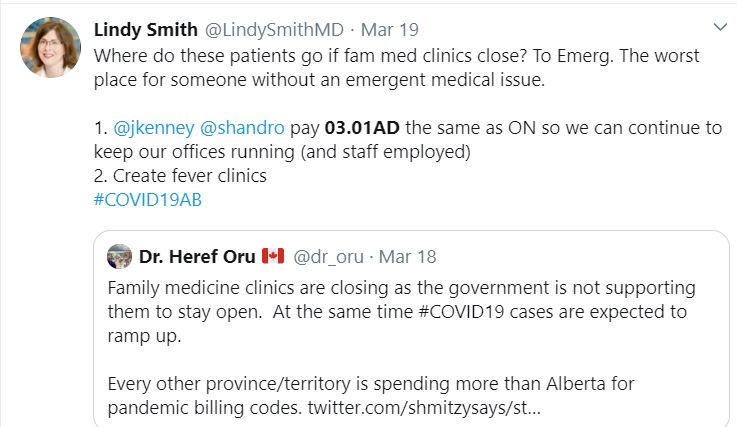
Then the doctors found out that billing code 03.01AD was the same amount as it was for H1N1, $20 per call. All the other provinces have updated their epidemic virtual care rates. But not Alberta. The doctors are outraged.


With the COVID-19 pandemic spreading rapidly, the UCP announced a measure which they said will keep people out of doctor's waiting rooms while accessing health care. They have contracted with Telus to offer an app whereby people could talk to a doctor remotely.  They did not discuss this with doctors.


At first glance, this may seem like a sensible idea. Except, you don't get to talk to YOUR doctor. You get to talk to a random doctor. Possibly not even located in Alberta. This might be fine for dealing with simple issues, but if you have complex health issues it would obviously be better to deal consistently with one doctor who knows your history. 

The thing is, doctors already can contact their patients on the phone. They can bill for this, but at a much lower rate (less than half) than an in-office appointment. 


Patients who may rely on having a physician who understands their complex concerns will not be able to access that doctor unless they go into the clinic, potentially putting themselves at risk of infection. Doctors will lose visit revenue. 


You may be thinking that doctors make a lot of money, so why should I care if they lose a bit of revenue to this Telus system? Think of it this way: doctors are small business owners. They pay rent, and utilities, and they pay for staff to manage records and make appointments. So their take-home pay is significantly less than what they bill.

Recall that the UCP wants to reduce doctors' billing rates. At the same time, they are skimming off patients to this Telus system. Like any small business, if there is not enough revenue to keep the lights on and pay staff, they will close their clinics and go elsewhere. We are already short of doctors in this province and the UCP seem determined to drive more of them away.


Doctors are understandably extremely unhappy about this. There is a pandemic and doctors are needed. Based on the examples of Italy and South Korea, doctors are going to be run off their feet looking after very ill people. This is not the time to be driving them away. 

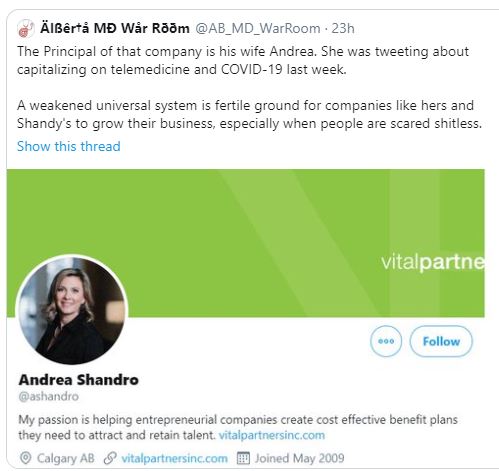
Or, so one might think. But recall, the UCP, like the CPC, is predicated on eliminating universal public health care. But they went after doctors, who are highly educated with quite decent research skills. And so this came to light:

It checks out.


And the ethics commissioner has signed off on this. The UCP respond to all this by pointing that out. But it was cleared by the ethics commissioner months before there was a pandemic or these new measures had been introduced by the government.  Of course, the ethics commissioner may be afraid to cross this government. Election commissioner, Lorne Gibson, was fired when he was investigating irregularities in the UCP's leadership race that saw Jason Kenney become leader.

Even the appearance of conflict of interest should be something the government takes seriously. However, it appears that they do not.


From the Vital Partners' website:

Matt Wolf, Jason Kenney's "Issues Manager" went on the offensive, attacking those who would criticise what appears to be a very blatant conflict of interest...


This key strategy of the UCP, to silence dissenting voices online, may not work this time. Doctors are furious. And they are not likely to let this go. More bits and pieces keep coming to light...


Stay tuned. As the COVID-19 Pandemic ramps up in Canada, Alberta's doctors are having to fight on 2 fronts at once.  I strongly suspect that Albertans, like most Canadians, are passionate about their health care. This will not go well for the UCP's reputation.


Wednesday, 4 March 2020

The Difference Between Being Canadian and Being Con - A Reply to Andrew Scheer

Jean Cretien was a Prime Minister of Canada. Something you will never be. Do you know why? I bet you don't. It's because the majority of Canadians are smart enough to see through the hate and fear-mongering from the likes of you. Most Canadians are progressive thinkers.
Most Canadians feel no animousity towards their fellow humans over sexual orientation, skin colour, religion, economic status... Most Canadians, in fact, actually care about people we have never even met. 
We are happy to pay taxes if it means a kid on the other side of the country gets life-saving treatment their family couldn't afford without our universal health care. We are outraged when people are discriminated against because of race, creed, colour, gender, orientation. 
We care. We want the most vulnerable in our society to succeed. We want to help make that happen. We want to make true reconciliation happen. We want to move away from fossil fuels so we can protect the environment. 
We want everyone's children to be fed and cared for and to receive an excellent secular education. We believe in science, compassion, empathy, and sharing. Our "family values" don't involve building walls, they are about making bigger tables. 
We believe in a woman's right to self-determination about her own body. We believe in everyone's right to choose how they die when confronted with intolerable circumstances. 
We want evolution taught in schools, and we think kids should go to schools where they can interact with children from different backgrounds so they can learn how to understand and accept and embrace diversity, because that is how the world is. 
Most Canadians realise that immigrants are entrepreneurs and major job creators. The bogey-man you and Harper and the CPC tried to create out of people fleeing for their lives doesn't have any traction with us. We see through you. 
"Barbaric cultural practices"? Please. Disproportionately carding black youth is a barbaric cultural practice. Writing anti-semetic slogans on synagogues and spitting on women in hijabs are barbaric cultural practices. But they are not mainstream Canadian practices. 
Your party, the CPC, wants to change Canada by making everything straighter and whiter and meaner. And you call yourselves Christians as though that was some sort of password to obscure what your goals are. 
You want "law and order" and stiffer sentencing, more punishment, calling it making communities safer. But all the research shows that does not make communities safer. Addressing underlying issues makes communities safer. 
Locking people up for longer and in worse conditions makes communities less safe. It creates a criminal underclass. It dehumanizes people, makes them dangerous. The US model is the very last model anyone should be looking to emulate. 
And that is in everything: education, health care, justice, election rules, environmental policy, international relations... Everything. And yet, your party, the CPC, seems to want to drag Canada into being a USA mini-me. We don't want it. 
You aren't really a westerner. You aren't really an insurance agent. You aren't really (based on the weird way the leadership vote was handled) the leader of the CPC. You aren't even 100% Canadian. And your party does not understand how Canadians feel. Not at all. 
How dare you claim to speak for any but the minority base that supports your party? Shouldn't you be out house-hunting? It takes time to find the right place, you know. Especially when you have to find somewhere with so many bedrooms. 

Saturday, 1 February 2020

Some Musings on Addictions and Harm Reduction

Anyone do dry January? I did. I called it tonight. Because there's a Jets game on and because January is a really long month. And because it was ok until a couple of days ago when I was looking at the calendar and arguing with myself. "28 days is four weeks. That's a month." Nope 
But, man, beer is lovely. And the first Moosehead Light (approaching drinking cautiously) hit me like a sledgehammer. Tipsy on one beer. And if I can remain mostly alcohol free going forward, I am going to be a "cheap date" from now on. Wow. 
Who'd a thought tolerance could go down so fast? And my point is, actually, that we need to have better systems in place to monitor and support people coming out of rehab. I keep hearing about people who OD shortly after coming out of rehab. 
They think a little won't hurt. They are out before they have resolved all their issues and the gnawing urge is still there. But what would have been a "little bit" back when they were using heavily, is too much once they have cleaned their system. 
We, as a society, need to do better. I have been reading "From the Ashes", one of the Canada Reads books. It reinforced my understanding that addicts aren't addicted because they are stupid, or morally bereft. Trauma causes addiction. And if we let these people die because 
we are too parsimonious to provide the care and support that is really needed, we are losing as a society. We are losing intellect, creativity, and the spark that makes a society strong. If we ban safe injection sites, and that crucial link with help and a new life, we fail. 
We fail those people. We fail their families and friends and community. We fail ourselves. @michifman has written a heart-wrenching and eye-opening memoir that demonstrates how labels do no good. How inadequate the public understanding and the public funding is in... 
addressing this huge social problem. No. It's not just indigenous people, or POC or poor people. Mental health, trauma, and addiction leave scars at all socioeconomic and cultural levels. "Son of a Trickster" by @Monkey__Beach reinforces this. Both amazing Canada Reads entries. 
We need to put aside our biases and pre-conceived notions. Addicts could be us, our children, our friends. Addiction doesn't care about income or skin colour. Emotional pain happens whoever you are and wherever you grew up. If you have been untouched by horror, consider yourself lucky. But don't look down on those who have faced extreme challenges. You aren't better than they. Just more fortunate. We need to push our governments at all levels to address this health crisis. A mental health crisis manifesting as a substance abuse crisis. 
OK. I went a bit darker than I meant to. But the issue is serious and we can't let old thinking govern how we address and fix these problems. It's complex. Let's not put bandaids on it. Here endeth the lesson.

Post-script: Jason Kenney came out claiming there is extensive research showing that harm reduction is bad. I would like to see this research.